1.1 General health and disability
| Men | Women | |
|---|---|---|
| Life expectancy at birth in years (2023) | 82.2 | 85.8 |
| Healthy life expectancy at birth in years (2022) | 70.7 | 71.1 |
| (Very) good self-perceived health1 (2022) | 85.7% | 84.0% |
| Long-standing health problem1 (2022) | 33.7% | 38.2% |
| Functional limitations (2022) | ||
| Eyesight: considerable or full impairment1 | 1.7% | 2.4% |
| Hearing: considerable or full impairment1 | 1.4% | 1.1% |
| Locomotion: cannot walk or can only walk a few steps1 | 0.7% | 1.0% |
| Speech: considerable or full impairment1 | 0.5% | 0.4% |
| Persons with disabilities2(2022) | 731 000 | 1 001 000 |
| of which severely limited | 139 000 | 186 000 |
1 population aged 15 or over living in a private household
2 population aged 16 or over living in a private household
Source: FSO – SHS, BEVNAT, STATPOP, SILC
© FSO 2025
Life expectancy in Switzerland is one of the highest in the world. Between 1990 and 2023, it increased by 8.2 years among men and by 5.0 years among women. Healthy life expectancy roughly stands at around age 71. In terms of this measure, the gap between men and women is small.
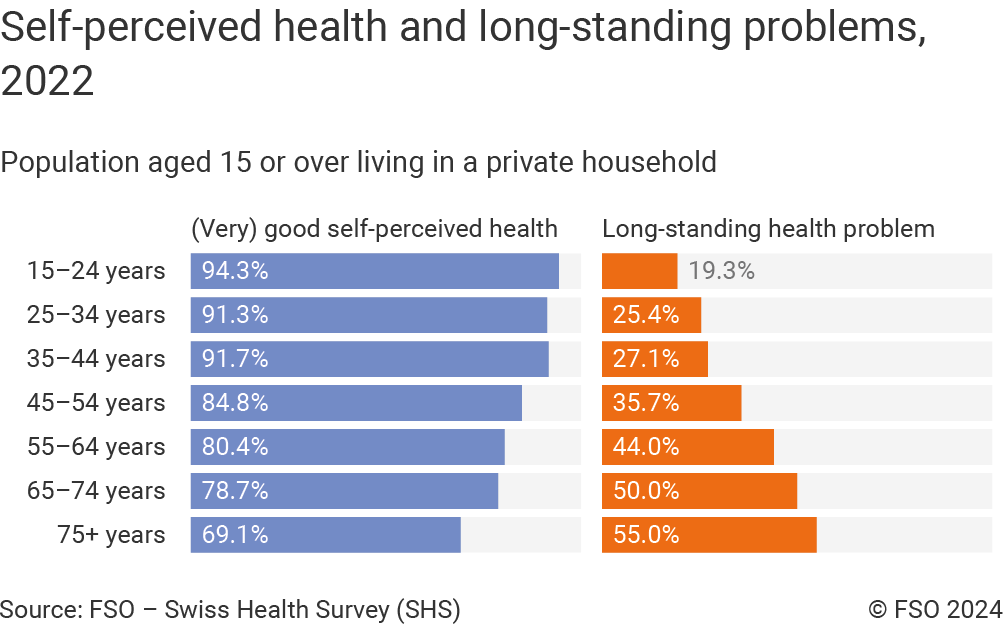
86% of men and 84% of women assessed their state of health as good or very good. With age, these proportions decrease and the general health worsens. From the age of 65, half of the population suffers from long-standing health problems.
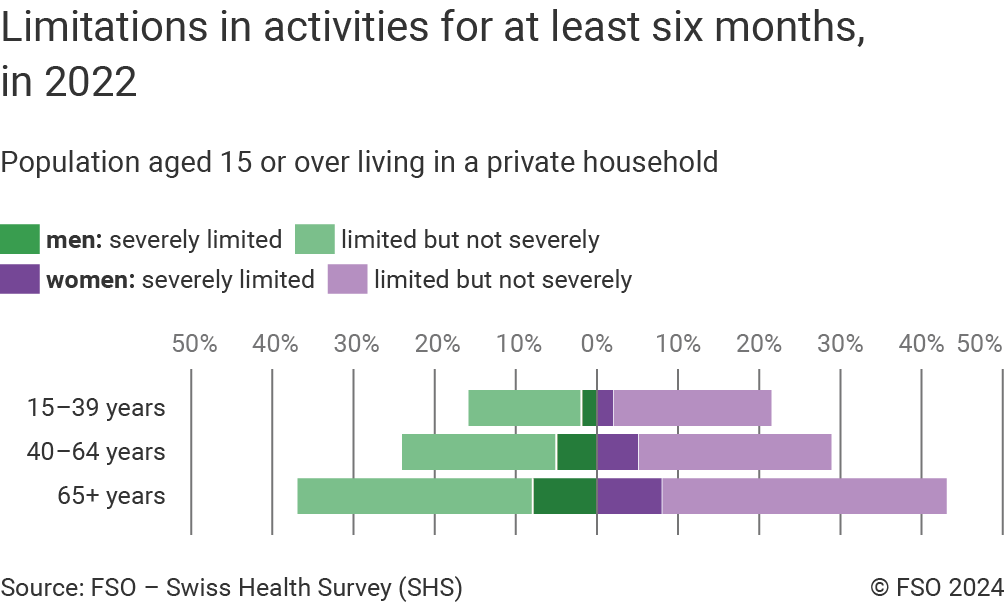
Limitations in activities people usually do, as well as functional limitations affecting eyesight, hearing and speech, increase with age. In 2022, 8% of persons aged 65 or over had been severely limited in their activities for at least six months. Approximately 1 732 000 persons, or 20% of the population, are considered to be disabled under the Disability Discrimination Act, of whom 325 000 are severely limited in activities people usually do.
1.2 Mental health
| Men | Women | |
|---|---|---|
| Happy all or most of the time (2022) | 84.4% | 82.6% |
| Medium or high psychological distress 1 (2022) | 14.4% | 21.1% |
| Moderate to serious depression 1 (2022) | 7.9% | 11.7% |
| Treatment for psychological problems 1 (2022) | 6.0% | 9.5% |
| Persons hospitalised for mental and behavioural disorders (2023) | 37 022 | 41 026 |
1 population aged 15 or over living in a private household
Source: FSO – SHS, MS
© FSO 2025
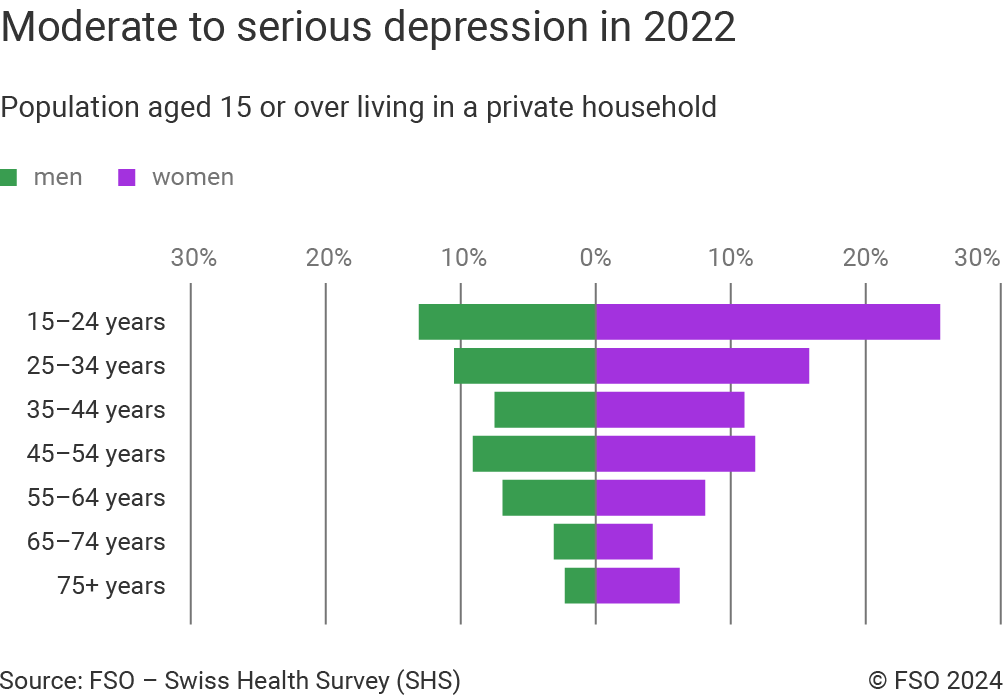
The vast majority of the population say that they experience positive emotions far more often rather than negative emotions: 84% of the population say that they are happy, while only 3% say they feel down or depressed. 90% of the population also have sufficient social support to cope with life’s difficulties. 18% of the population, however, show signs of medium (14%) or high psychological distress (4%). Depression is the most common mental disorder. 8% of men and 12% of women suffered from moderate to serious depression in 2022. Young people aged 15 to 24 are the most frequently affected.
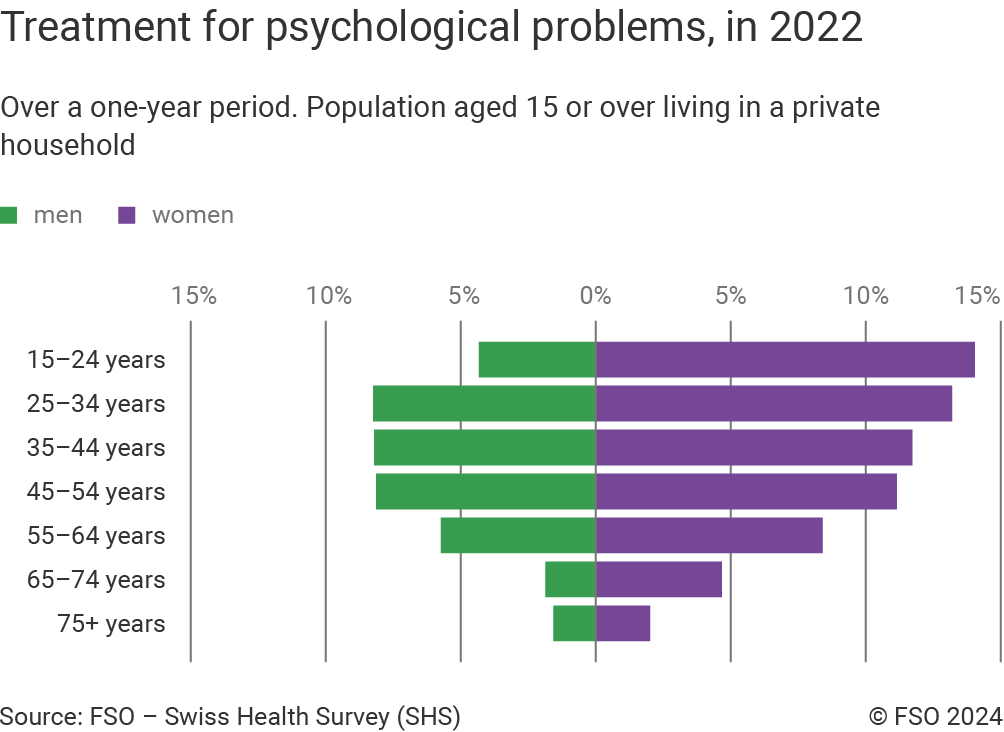
In 2022, 8% of the population were in treatment for psychological problems and 9% used at least one psychotropic drug (antidepressant, sleeping pill, sedative). Women use psychotropic drugs more often than men, and older people significantly more than younger people. In addition, just over 1% of persons in the age group 15–24 years took medication for attention disorders in 2022.
In 2023, 114 146 hospitalisations due to mental and behavioural disorders were recorded. It is common for the same person to be hospitalised several times for different mental or behavioural disorders. Mood disorders (mainly depression) are the most frequent cause (29%) of these hospitalisations. The share of hospitalisations due to mental disorders, such as schizophrenia, is 14%. Men in the 25–44 age group are most frequently affected by these disorders. Disorders related to the consumption of alcohol and other psycho-active substances are the cause of 22% of these hospitalisations; men are affected 2.1 times as often as women.
1.3 Cardiovascular disease and diabetes
| Men | Women | |
|---|---|---|
| Persons hospitalised due to cardiovascular diseases (2023) | 67 899 | 47 465 |
| Number of deaths due to cardiovascular diseases (2023) | 9 359 | 11 017 |
| Acute myocardial infarction, number of cases (2023) | 12 909 | 6 725 |
| Stroke, number of cases (2023) | 12 132 | 10 385 |
| Hypertension 1 (2022) | 22.4% | 16.8% |
| Excessively high levels of cholesterol 1 (2022) | 17.4% | 12.2% |
| Diabetes 1 (2022) | 6.9% | 4.0% |
1 population aged 15 or over living in a private household
Source: FSO – MS, CoD, SHS
© FSO 2025
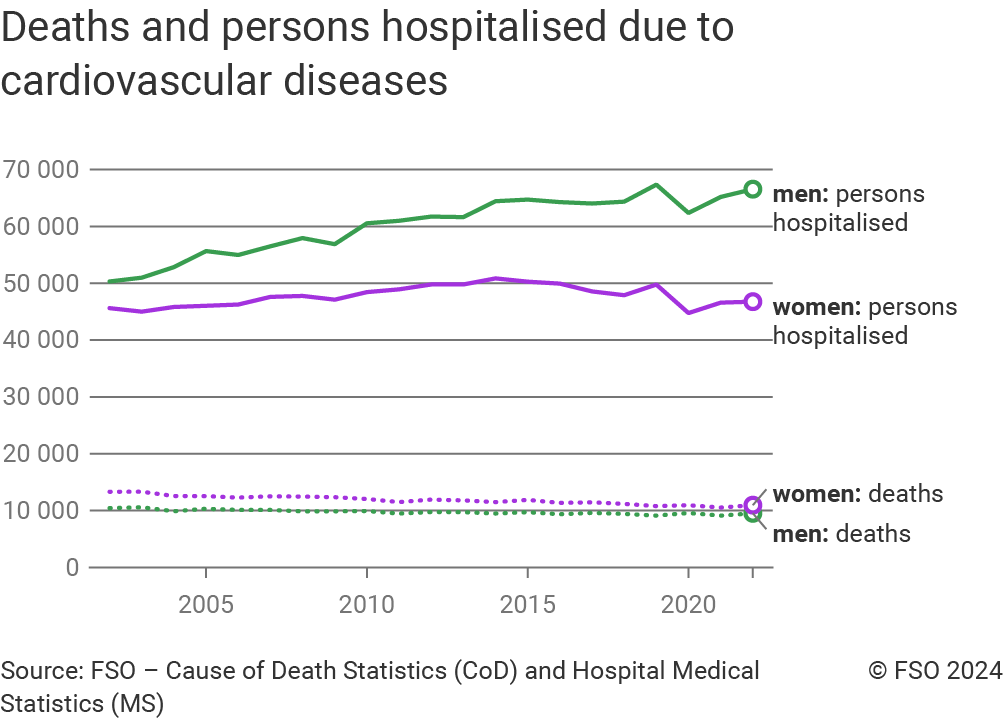
Cardiovascular diseases are the first most common cause of death – and the third most common cause of hospitalisation. Since 2002, the number of hospitalisations for cardiovascular diseases has increased by 20% very likely as a result of increasing population numbers and an ageing population. Over the same period, the number of deaths caused by these illnesses however has fallen by 14%. In 2023, 19 634 people (two thirds of whom were men) suffered an acute myocardial infarction and 2181 people died from this. The respective numbers for strokes are 22 517 (slightly over half of which are men) and 2580.

The share of persons suffering from hypertension was 20% in 2022. Men are more affected than women until the age of 75. From the age of 75 onwards, more than half the population has blood pressure that is too high. The share of people whose cholesterol level was too high was 15% in 2022.
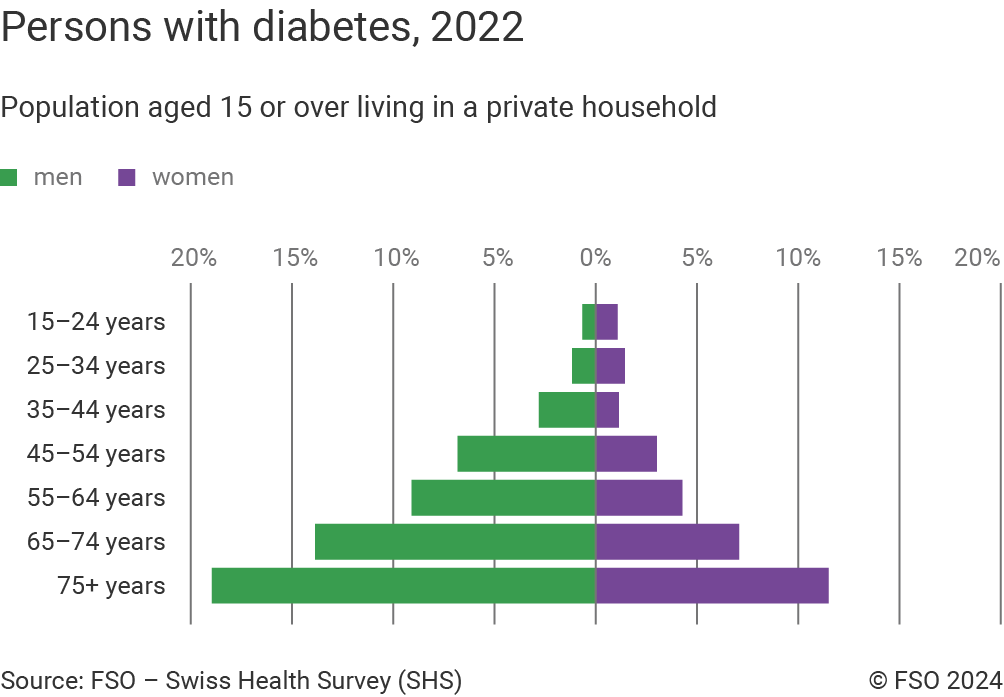
In 2022, 6% of men and 4% had diabetes. People with a low level of education are almost three times as likely to suffer from diabetes as those with a high-level education (11% compared with 4%).
1.4 Cancer
| Annual average (for the period 2017–2021) |
Men | Women | ||
|---|---|---|---|---|
| New cases | Deaths | New cases | Deaths | |
| All cancers | 25 618 | 9 376 | 21 063 | 7 756 |
| Lung, bronchi, trachea | 2 824 | 1 923 | 2 125 | 1 337 |
| Breast | 6 617 | 1 368 | ||
| Prostate | 7 827 | 1 356 | ||
| Colon-rectum | 2 509 | 906 | 1 986 | 726 |
| Melanoma | 1 794 | 169 | 1 512 | 117 |
| Cancer among children 1 (all types) | 135 | 13 | 115 | 13 |
1 0–14 years
Source: FSO, NCR, SCCR – National cancer statistic
© FSO 2025
Nearly 47 000 new cases of cancer were diagnosed on average every year in the 2017–2021 period. More than one in five people will develop a cancer before the age of 70. Men are more affected by cancer and die from cancer more often than women do. For the period observed (1992–2021), the rate of new cases among men increased until 2006, after which it stabilised at a slightly lower level. Among women, the rate of new cases increased until 2016, and then remained stable up until the most recent period. Mortality is decreasing for both sexes.
Prostate cancer is the most common cancer among men but it is cancer of the lung, bronchi and trachea that cause the most deaths. Breast cancer is the most common cancer among women. Along with lung cancer, it is also responsible for the most deaths.
Every year between 2017 and 2021, about 250 children aged 14 and under got cancer and about 27 died from this disease. Leukaemia (30%) and tumours of the central nervous system (24%) are the two most common types of cancer in children.
1.5 Infectious diseases
| 2023 | |
|---|---|
| New diagnoses of HIV | 349 |
| New cases of tick-borne encephalitis | 300 |
| New cases of tuberculosis | 418 |
Source: FOPH – Reporting System for Notifiable Infectious Diseases
© FSO 2025
The number of new cases of infection with the HIV virus has fallen sharply since 2009. Other cases of other sexually transmitted diseases are not decreasing.
The main infectious diseases transmitted by ticks are Lyme disease (8000 to 15 000 cases per year) and meningoencephalitis (300 cases in 2023). The latter affects men about 1.5 times more often than women.
The number of new cases of tuberculosis has decreased over the past ten years; the majority of cases occur in people of foreign origin who come from a country with a high incidence of tuberculosis.
Until the appearance of COVID-19, influenza was the main seasonal infectious disease. It may require hospitalisation, especially among older persons (3425 cases per year on average from 2019 to 2023). Winters with strong influenza epidemics are marked by excess mortality.
1.6 Diseases of the respiratory system
| 2023 | |
|---|---|
| People hospitalised due to asthma | 2 611 |
| People hospitalised due to chronic obstructive respiratory disease | 8 749 |
| People hospitalised due to pneumonia | 25 628 |
| People hospitalised due to acute bronchitis or bronchiolitis | 6 923 |
Source: FSO – Hospital Medical Statistics
© FSO 2025
Diseases of the respiratory system can be chronic or acute. Among chronic diseases, 6% of the population suffered from asthma in 2022 and 2.5% from a chronic obstructive bronchial or pulmonary disease. Asthma is more common in people aged under 35. In contrast, people aged at least 75 are most affected by chronic obstructive disease. The latter are the cause of more hospitalisations than asthma and of a greater number of deaths (2161 compared with 88 in 2023).
Among acute diseases of the respiratory system, pneumonia is the cause of the greatest number of people hospitalised (25 628 in 2023) and deaths (1215 in 2023). Acute respiratory disease is extremely seasonal in nature, leading to increased take up of health care services during the winter months.
1.7 Musculoskeletal disorders
| Men | Women | |
|---|---|---|
| People with back or kidney problems (2022) | 40.1% | 50.0% |
| Persons with osteoarthritis or arthritis (2022) | 11.8% | 19.6% |
| Persons with osteoporosis1 (2022) | 1.4% | 9.7% |
| Persons hospitalised for musculoskeletal disorders (2023) | 72 681 | 86 154 |
| Hip replacement | 13 348 | 16 329 |
| Knee prothesis | 11 405 | 15 389 |
1 from age 45
Source: FSO – Swiss Health Survey (SHS), Hospital Medical Statistics (MS)
© FSO 2025
Back pains or lower back pains are the most common physical problems: 45% of the population suffer from these. The proportion of the popu-lation affected by osteoarthritis or arthritis increases sharply with age, reaching 42% from the age of 75.
Musculoskeletal disorders are the most common cause for hospitalisation after traumatic injuries. Disorders of the limb joints (osteoarthritis, arthritis) and back problems are the reasons for 53% and 23% of these hospitalisations. The use of protheses is sometimes necessary. In 2023, 29 677 persons were hospitalised for hip replacements. This is 42% more than in 2010. Knee protheses are slightly less common (26 794).
1.8 Births and health of newborns
| 2023 | |
|---|---|
| Live births | 80 024 |
| Average age at maternity | 32.4 |
| Rate of caesareans | 33.5% |
| Premature births (< 37 completed weeks of pregnancy) | 6.2% |
| Low birth weight births (< 2500 g) | 5.9% |
| Stillbirths | 4.2‰ |
| Infant mortality (before the age of one) | 3.3‰ |
| Twins | 3.0% |
Source: FSO – BEVNAT, MS, CoD
© FSO 2025
The average age of mothers at maternity has continued to increase since the 1970s. In 2023, the share of women under the age of 30 who had given birth was less than 25% compared with 70% in 1970. 95% of births take place at the hospital and a third of deliveries are by caesarean. The rate of caesareans vary by up to 100% depending on the region.
265 infants and children under the age of one died in 2023. This corresponds to a rate of 3.3 deaths per thousand live births. 55% of these deaths occurred in the 24 hours following birth. Above all infant deaths affect children with a very low birth weight or those born very prematurely. The same year 334 stillbirths were registered.
3.0% of children were born as twins and 0.04% as triplets. 2370 children were born as a result of a treatment in 2022 using assisted reproduction technology by in-vitro fertilisation, i. e. 3.0% of live births.
1.9 Causes of death
| Men | Women | |
|---|---|---|
| Total deaths (2023) | 35 109 | 36 713 |
| Cardiovascular diseases | 9 359 | 11 017 |
| Cancer | 9 438 | 7 629 |
| COVID-19 | 744 | 613 |
| Dementia | 2 077 | 4 370 |
| Accidents | 1 573 | 1 459 |
| Suicide (except assisted suicide) | 721 | 274 |
| Assisted suicide | 693 | 1 036 |
Source: FSO – BEVNAT, CoD
© FSO 2025
In 2023, 71 822 deaths were recorded, 4% more than in 2022.The most common causes of death were cardiovascular disease (28%) and cancer (24%). For the first time since 2020, COVID-19 (2%) was no longer among the five leading causes of death. The table shows the main causes of death which vary greatly by age group.
Perinatal causes of death predominate in the first year of life, followed by congenital diseases. Although death from the age of 1 to 14 is uncommon, there are many different causes. The majority of deaths from the age of 15 to roughly 45 are caused by accidents and suicide. After this age, the most common cause of death is cancer. From around the age of 80 this is overtaken by cardiovascular diseases. In 2020, it was observed that COVID-19 related deaths also varied by age: the percentage of people who died from COVID-19 was greater among those aged 65 and over than among younger people.
995 people committed suicide in 2023. The vast majority were men (72%) and almost half (47%) were under 55. In the same year, the number of assisted suicides was 1729. Women account for the majority (60%) and about nine out of ten (91%) persons seeking assisted suicide are over 64. Assisted suicide is mostly requested by persons suffering from serious and incurable diseases such as cancer (33%) or neurodegenerative diseases (11%). From the age of 65, assisted suicides outnumber suicides.