Students and costs in higher education
In recent years, student numbers have constantly increased at the three types of higher education institution. The majority of students are enrolled at universities and institutes of technology (UNI): in 2020 164 575 students were enrolled, corresponding to a five-year increase of around 13%. Higher education costs rose by more than 10% over the same period, reaching a total of more than CHF 8.8 billion.
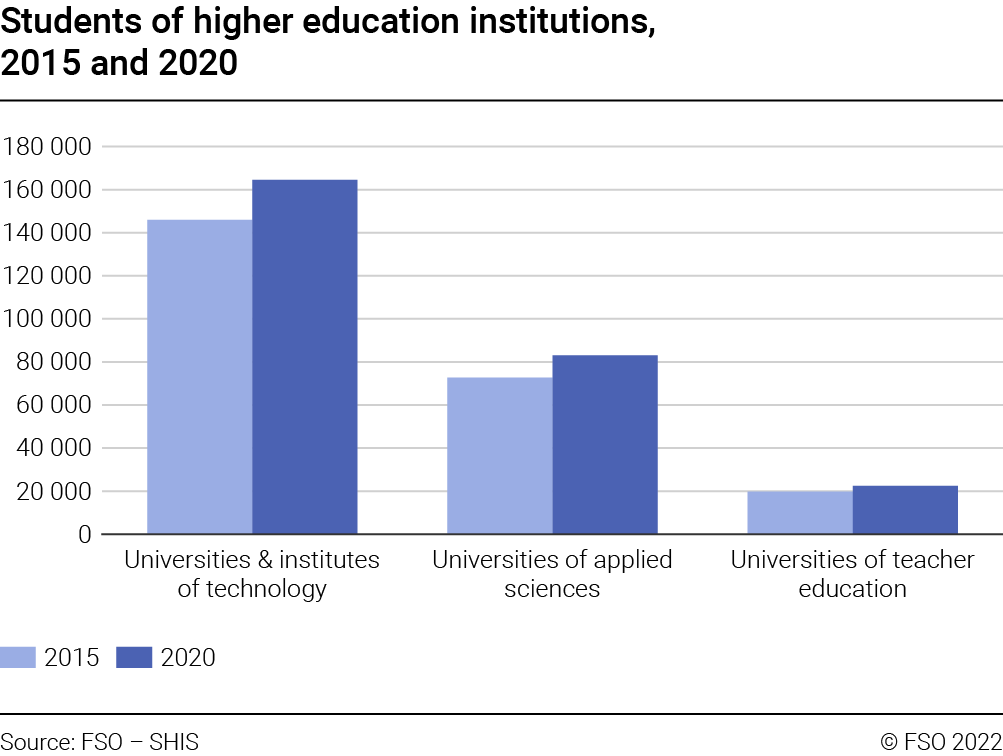
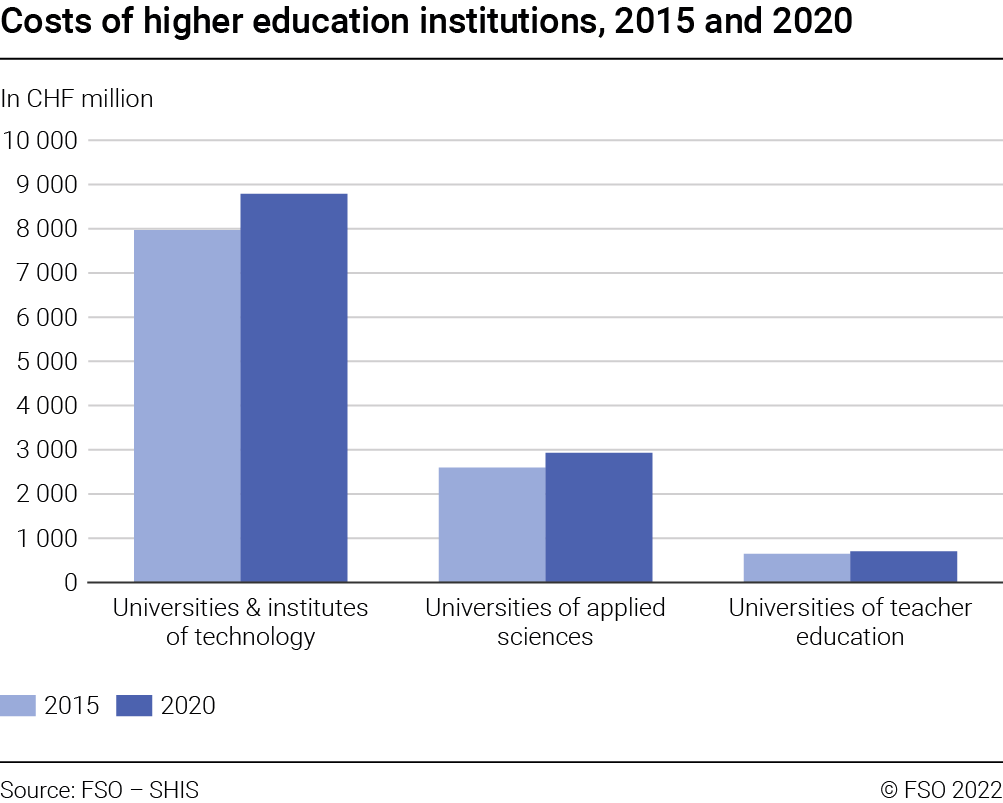
The greatest relative increase in the number of students, however, was seen by the universities of applied sciences (UAS) with an increase of around 14% with more than 83 000 registrations in 2020. At 13%, costs of UAS increased in comparison with the students almost as much and reached in excess of CHF 2.9 billion.
The growth of the universities of teacher education (UTE) was comparable between 2015 and 2020 with over 22 500 students registered, i.e. an increase of 14%. The annual growth stabilised compared with previous years. The total cost of this type of higher education institution is now greater than CHF 700 million, i.e. 8% more over the same period.
Excursus: Finance of higher education institutions
and the COVID pandemic
The increase in the number of students in basic tertiary education and training (diploma/bachelor/master) was higher than average for all types of higher education institutions compared with previous years (increase between 2019 and 2020: UNI 5.7%, UAS 4.7%, UTE 5.8%; average annual increase between 2015 and 2019: UNI 1.7%, UAS 3%, UTE 2.3%), which was due to the higher number of first-year students.
Although total costs rose between 2019 and 2020, the increase was below average in comparison with the previous years (increase between 2019 and 2020: UNI 0.8%, UAS 1.6%, UTE 0.6%; average annual increase between 2015 and 2019: UNI 2.4%, UAS 2.7%, UTE 1.6%). Material costs fell almost without exception for all types of activity (UNI: –16% to –5%, UAS: –20% to –6%, UTE: –12% to –6%, with the exception of UTE material costs for basic tertiary education and training: +2%). Although IT investments rose, laboratory costs and travel declined.
As a result, the costs per student in 2020 compared with the average cost between 2015 and 2019 decreased in most fields of study (UNI: for more than 90% of the fields of study, UAS: for more than 80% of the fields of study, UTE: for more than 90% of the fields of study).
Total revenue increased to a lesser extent (increase between 2019 and 2020: UNI 0.8%, UAS 0.7%, UTE 0.8%; average annual increase between 2015 and 2019: UNI 2.4%, UAS 2.9%, UTE 1.5%). The revenue in the types of activity “Continuing education and training” (UNI: –3.2%, UAS: –3.8%) and “Provision of other services” (UNI: –3.2%, UAS: –11.2%) actually fell in comparison with the previous years, except for at the UTEs. This decrease results from the cancellation (sports) or postponement of some face-to-face activities or from the change to another form of teaching and learning (e-learning).
Costs per student in higher education
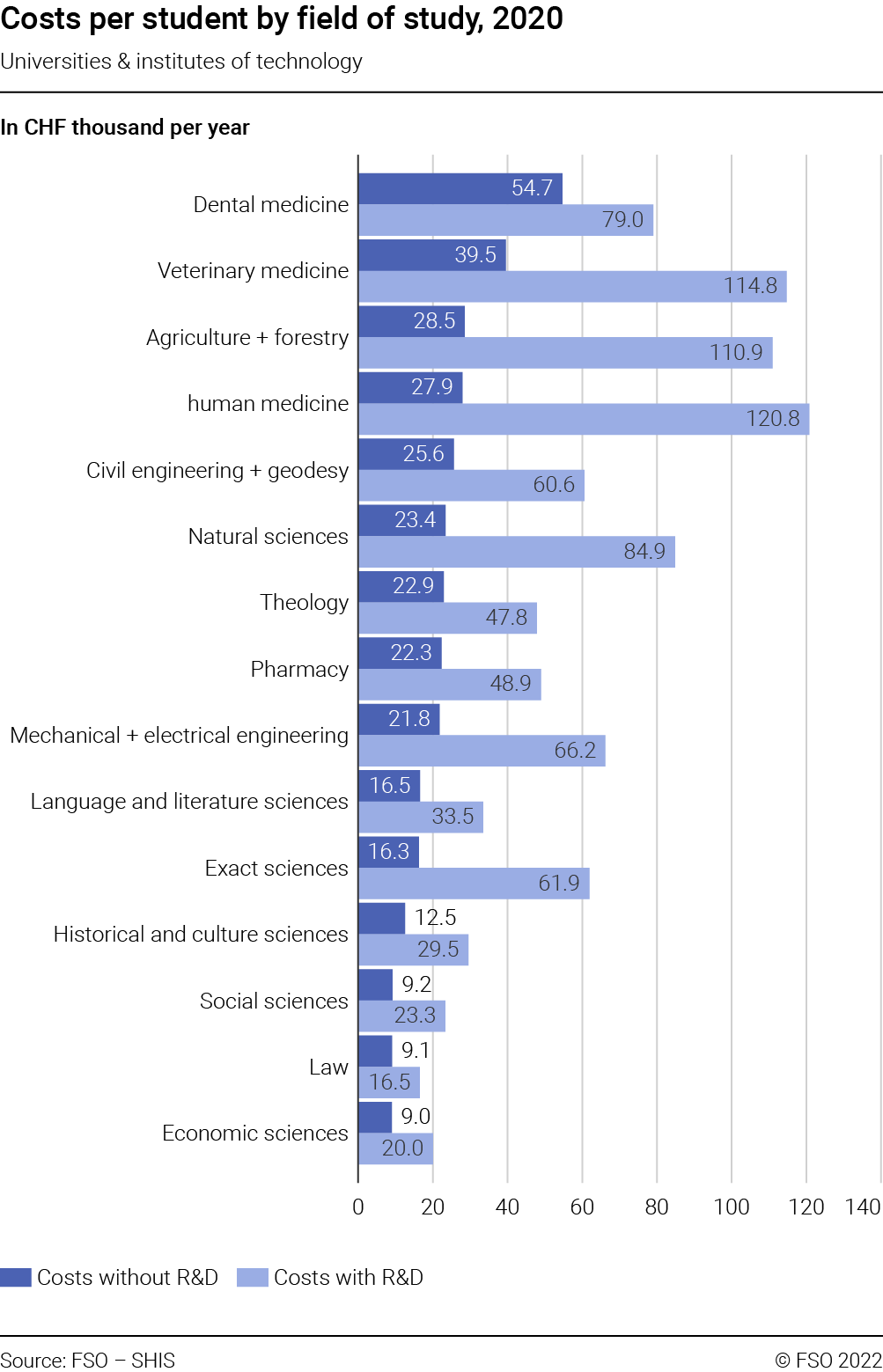
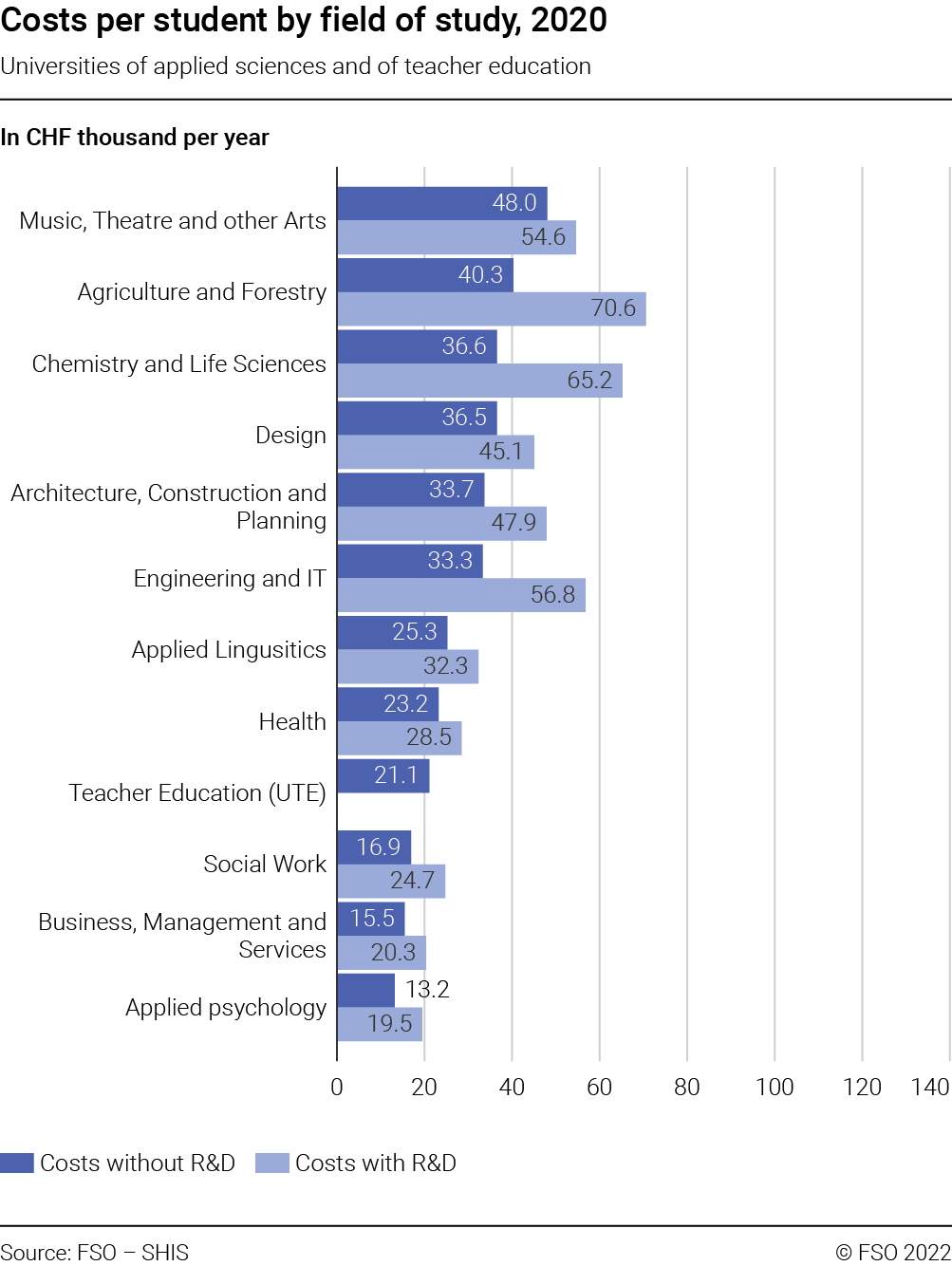
Cost indicators per student allow average costs to be compared between the different categories of study. On average, a university student costs between CHF 9000 and CHF 55 000. This indicator ranges from 13 200 to 48 000 per year in the universities of applied sciences and the universities of teacher education. If, in addition to teaching, research and development (R&D) is also included in the calculation, the costs per student increases considerably. For the universities, the least costly fields cost around CHF 16 500, while the most expensive can cost more than CHF 120 000. In the universities of applied sciences, the minimum costs is around CHF 19 500, while the maximum cost is below CHF 71 000.
Types of activities at higher education
institutions
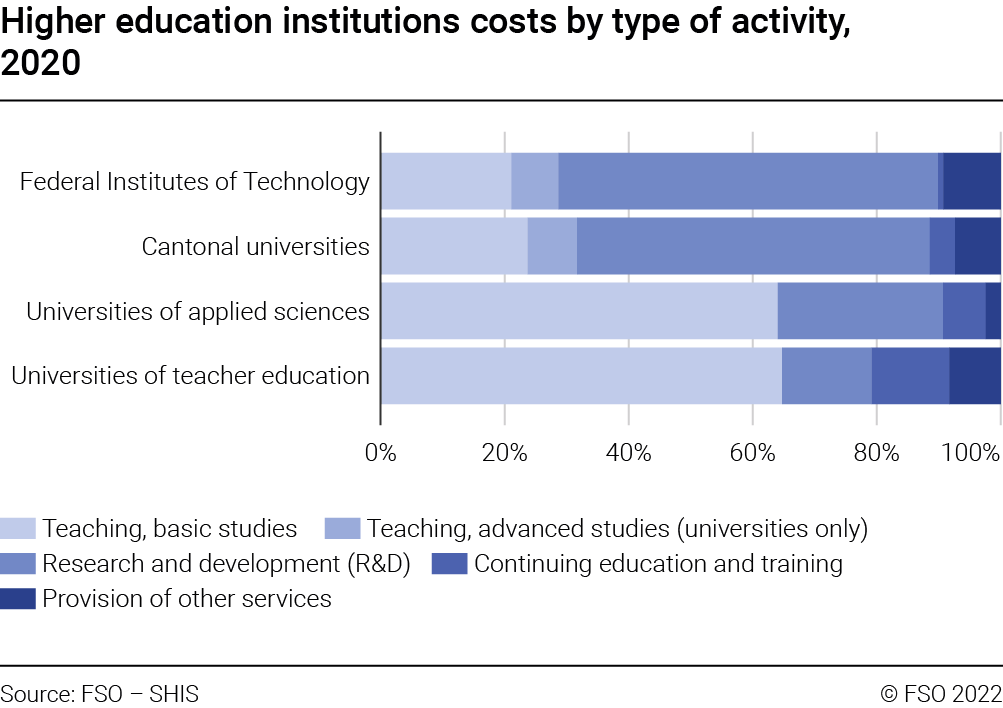
The universities provide five types of higher education: teaching for basic studies, teaching for advanced studies, research and development, further education and the provision of other services. In this type of higher education institution, which includes the cantonal universities as well as the two EPF/ETH, research and development represent the largest budgetary item, with more than half of the costs. In second place comes teaching for basic studies, which generates almost a quarter of the costs of these universities.
In the universities of applied sciences and the universities of teacher education, the courses of study are oriented towards obtaining skills linked to a well-defined occupation. They offer an education and training that is practical in nature and for this reason, the teaching of basic studies is by far the main service provided with almost two-thirds of all costs in these two types of establishment. Applied research and development represents the second biggest cost item in the universities of applied science; in the universities of teacher education, continuing education and research generate similar costs.
Funding of higher education
While the following data for UAS and UTE are also based on their cost calculations, the data source for the UNI is the expenditure statistic. This is because the cost accounting model of the UNI does not allow for detailed funding information.
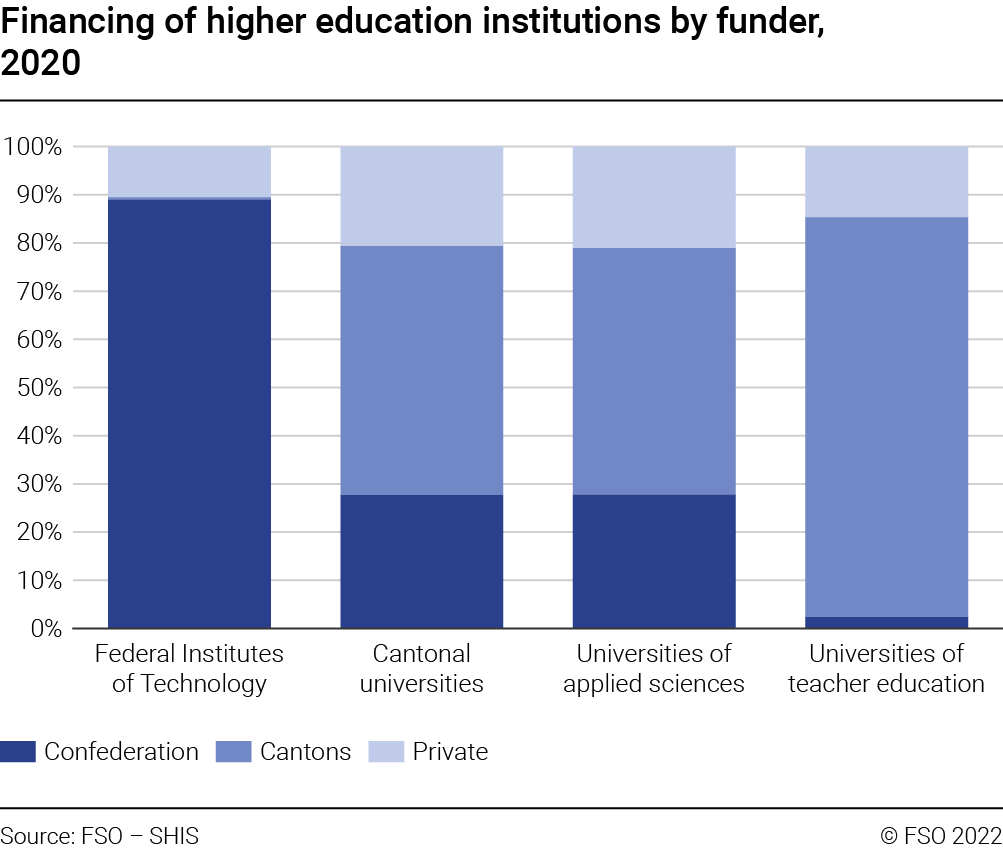
Since 1999 Since the coming into force of the Federal Act on University Funding and Cooperation in the field of University Education (UFundA). Its successor, the Higher Education Act (HEdA), came into force in 2016. the Confederation (28%) and cantons (52%) have been responsible for most funding of the cantonal universities. More than 89% of the costs of the federal institutes of technology (EPF/ETH), which fall within the responsibility of the Confederation, are met by federal funding sources, in particular global EPF/ETH budgets.
The cantons (51%) are the main funder of the universities of applied sciences, through ICA-UAS contributions Intercantonal Agreement on Universities of Applied Sciences and budgetary coverage of the cantons responsible. Similarly to the universities of applied sciences and by means of the same sources of funding, the cantons are the main funders of the universities of teacher education and cover some 83% of their needs.