On the one hand, ecosystems produce services that are useful to people. On the other hand, human activities require natural resources such as water, soil, energy or material. The way in which resources are used affects the supply available, particularly in the case of non-renewable resources.

Around 80% of drinking water comes from groundwater sources, approximately half of which is spring water. The remaining drinking water is taken from lakes and rivers. In 2019, 928 million cubic metres of drinking water were produced. The consumption of drinking water in Switzerland has decreased by 20% since 1990.
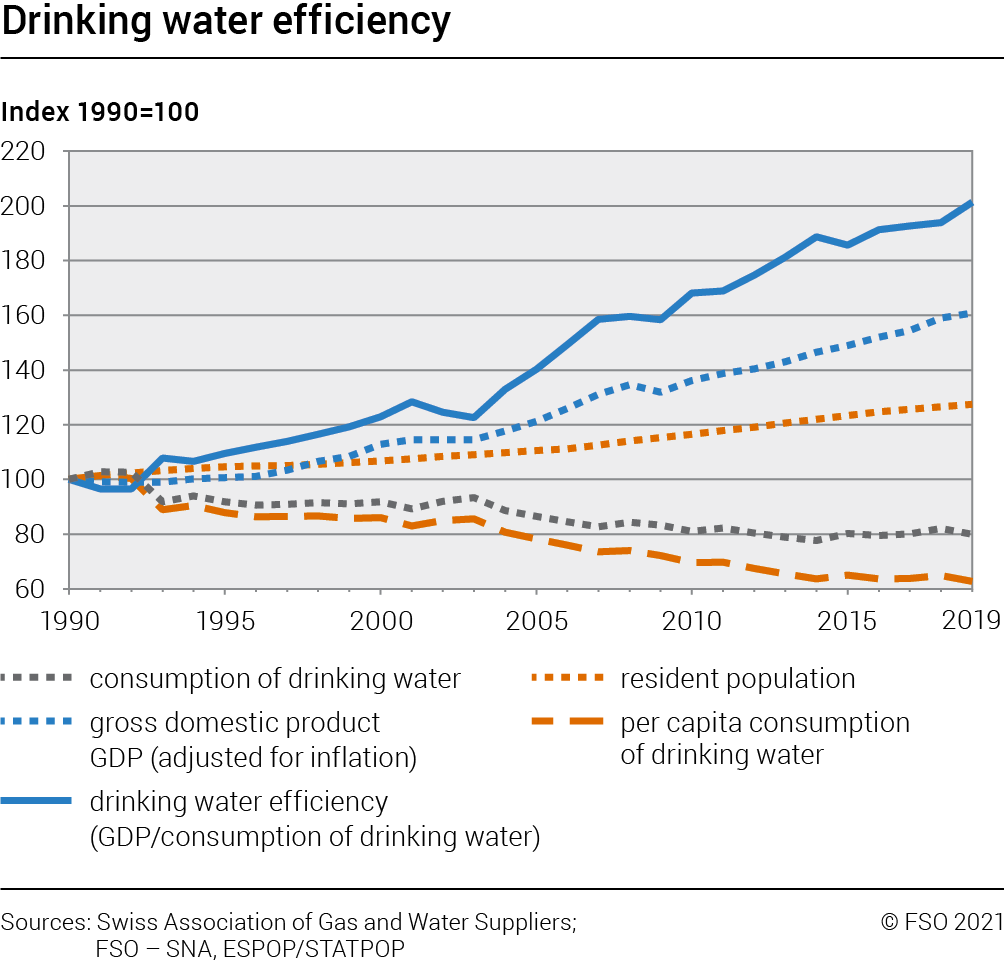
The consumption of drinking water has become more efficient since 1990 – the needs of a growing economy were able to be covered by the use of less drinking water. The per capita requirement for drinking water has also decreased: in 1990, daily consumption was 472 litres per person, in 2019, this figure was 295 litres. The water that is used abroad to produce imported products is, however, not included in this figure.

7.5% of Switzerland is covered by settlement and urban areas. Within 24 years, the settlement and urban areas have grown by 23% or 584 km2, mainly at the expense of agricultural areas. This is equivalent to an area increase of nearly 0.75 m2 per second.

Since the period 1979/85, the settlement and urban areas have grown faster than the population. The settlement and urban area requirement per person has therefore increased: according to the latest figures, this requirement is approximately 407 m2 per person, which is roughly 20 m2 more than 24 years ago.

In the short term, energy consumption is dictated by the economic situation and weather conditions. In the long term, however, population and economic trends as well as technological and lifestyle changes are also important influencing factors. In 2019, approximately 75% of the energy used in Switzerland came from abroad. Gross energy consumption stood at 1.1 million terajoules.

Between 1990 and 2019, electricity consumption in Switzerland increased by 23%, although since the mid-2000s this has been seen to stabilise. In 2019, around 57 200 gigawatt hours of electricity were consumed, corresponding to approximately 6650 kilowatt hours per person. By way of comparison, this figure was 6900 in 1990. In 2019, 56% of domestically produced electricity came from hydropower and 35% from nuclear energy. The remainder came from conventional thermal power plants (4.2%) and various renewable sources (4.2%), such as biogas, as well as solar and wind energy.
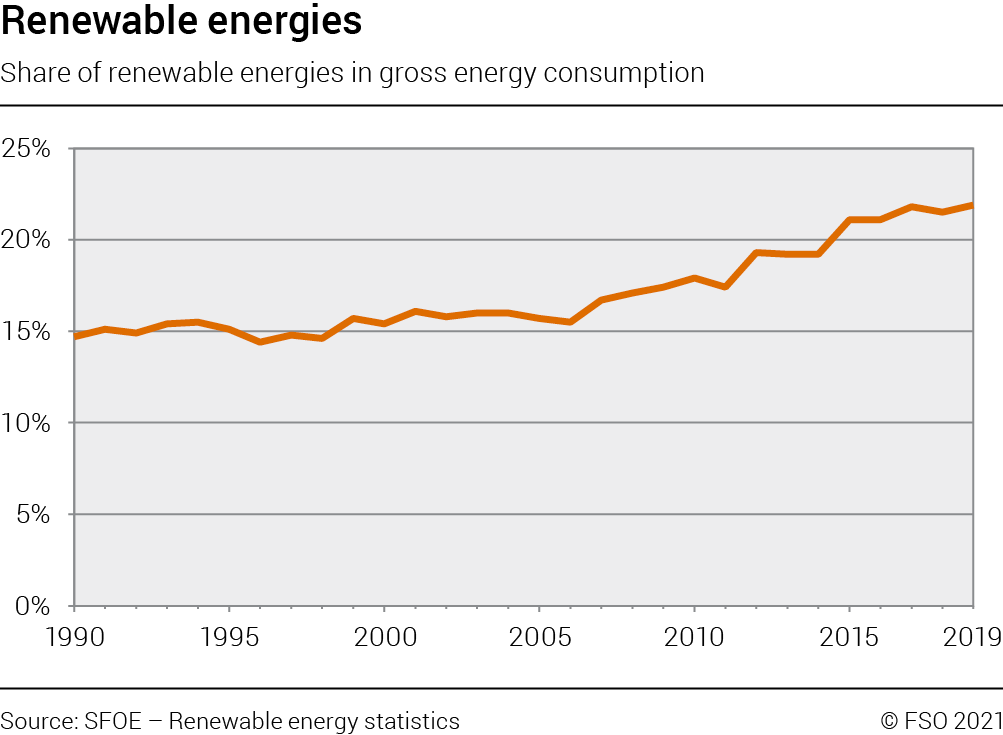
In 2019, 21.9% of gross energy consumption came from renewable sources. 60% of renewable energies were obtained from hydropower, followed by wood with 18% and energy generation from renewable waste with 11%. Ambient heat (7.5%), solar energy (4.3%), biofuel (3.2%), biogas (2.3%), and wind energy (0.2%) were involved to a lesser extent in the production of energy. Between 1990 and 2019 the consumption of renewable energies rose by 62%, a greater increase than that seen for total energy consumption which rose by 8% over the same period.
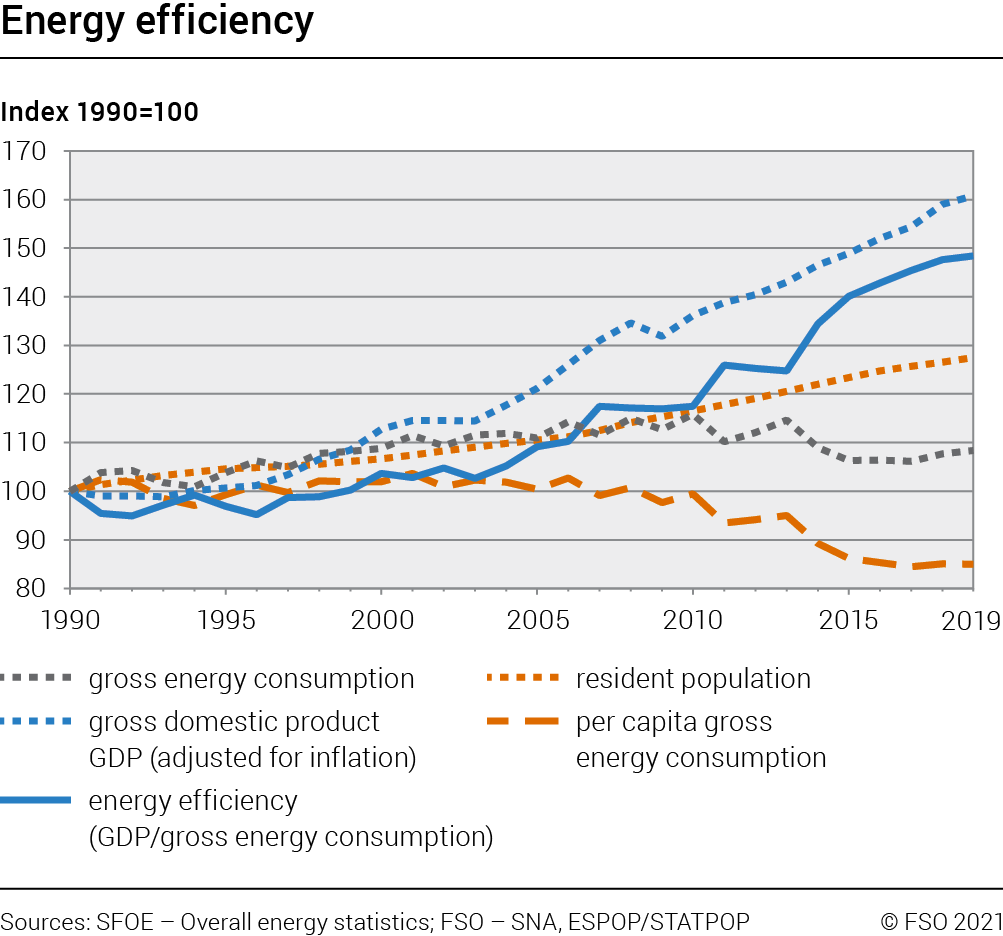
Since 1990, both the gross domestic product (GDP) and the resident population have grown more considerably than gross energy consumption: In 2019, less energy had to be used to generate one Swiss franc and less energy was used per capita than in 1990. However, this does not include so-called “grey energy”, i. e. the energy that has been used abroad for the production and transport of imported products.

Since 2000 Switzerland’s material footprint – measured by domestic raw material consumption (RMC) – has risen by approximately 10%. This corresponds to the amount of raw materials extracted in Switzerland or abroad to meet Swiss final demand. In 2019, the material footprint was 147 million tonnes. Over this period raw material extracted in Switzerland accounted on average for 43% of the footprint. Expressed in tonnes of raw material, imports increased by 25% between 2000 and 2019.

Switzerland’s raw material consumption (RMC) or material footprint was around 17 tonnes per capita in 2019 and was therefore lower than the level measured in 2000. However, the gross domestic product (GDP) has increased more than material consumption since 2000: This means that in 2019, a higher value added was attained per material amount used than in 2000.

In 2020, around 43 000 hectares of cultivated area benefited from pollination by animals, corresponding to 4% of utilised agricultural area and 14% of arable and perennial crop areas. Particularly in the case of fruit or berries, but also rapeseed and sunflowers, production is stimulated by pollinators. The remaining arable land is used mainly for cereal crops whose pollination takes place by the wind.

In 2019, 39% of the Swiss population indicated that they spent their leisure time outdoors, every day or almost every day. Another 39% do this at least once a week. Only 6% of the population says they spend their leisure time outdoors less than once per month.