While less decisive than socio-demographic characteristics or individual factors (see sub-chapter 3.1), regional characteristics also play a role with regard to attitudes towards diversity. Depending on the type of region, the aforementioned attitudes will be more or less favourable. The population living in urban zones and cities are more open to migration and otherness. Urban zones are places where diversity is more likely to be encountered.
Using data from the 2020 survey on diversity and coexistence in Switzerland (VeS), this chapter presents people’s attitudes towards diversity according to their location in the Swiss geographic area and the type of region in which they live. Due to the size of the survey sample, which does not permit analyses at cantonal level, the spatial variables retained are the major regions, the language regions and the degree of urbanisation. The variables adopted refer to the standard regionalisation typologies Regionalisation of data is understood here as a geographic break-down of Swiss space according to selected criteria or typologies. of the Federal Statistical Office (FSO) FSO website: www.statistics.admin.ch → Look for statistics → Cross sectional topics → Territorial analyses → Geographic levels → Analysis regions . They are also used to break down standard indicators on diversity and coexistence after each biennial survey The standard indicators can be found on the FSO website: www.statistics.admin.ch → Look for statistics → 01– Population → Migration and integration → Diversity and coexistence .
4.1 Major regions
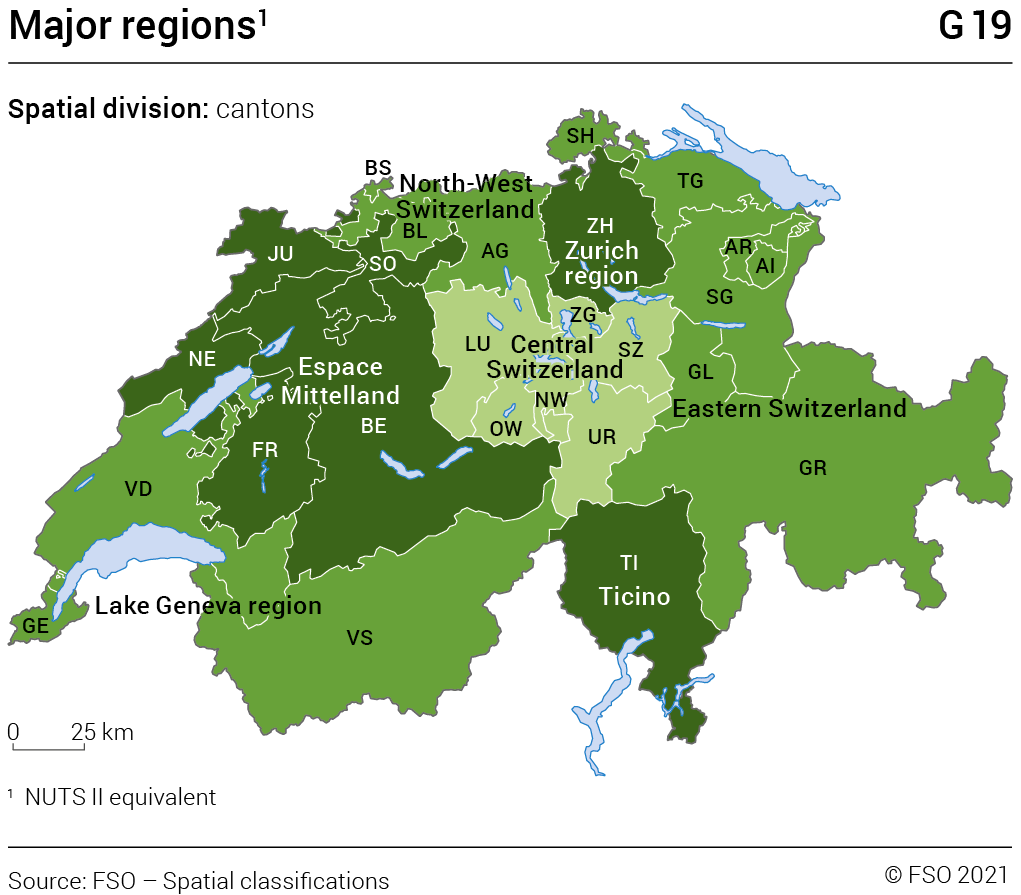
By drawing the sample per regional frame stratum and through a weighting procedure, the results of the survey on diversity and coexistence in Switzerland (VeS) are representative with regard to the major Swiss regions (G19). For regional and international statistical comparison purposes, seven major regions have been created based on the cantonal boundaries. These regions are equivalent to the NUTS 2 regions of EUROSTAT Statistic Office of the European Union and level TL2 of the OECD Organisation for Economic Co-operation and Development .
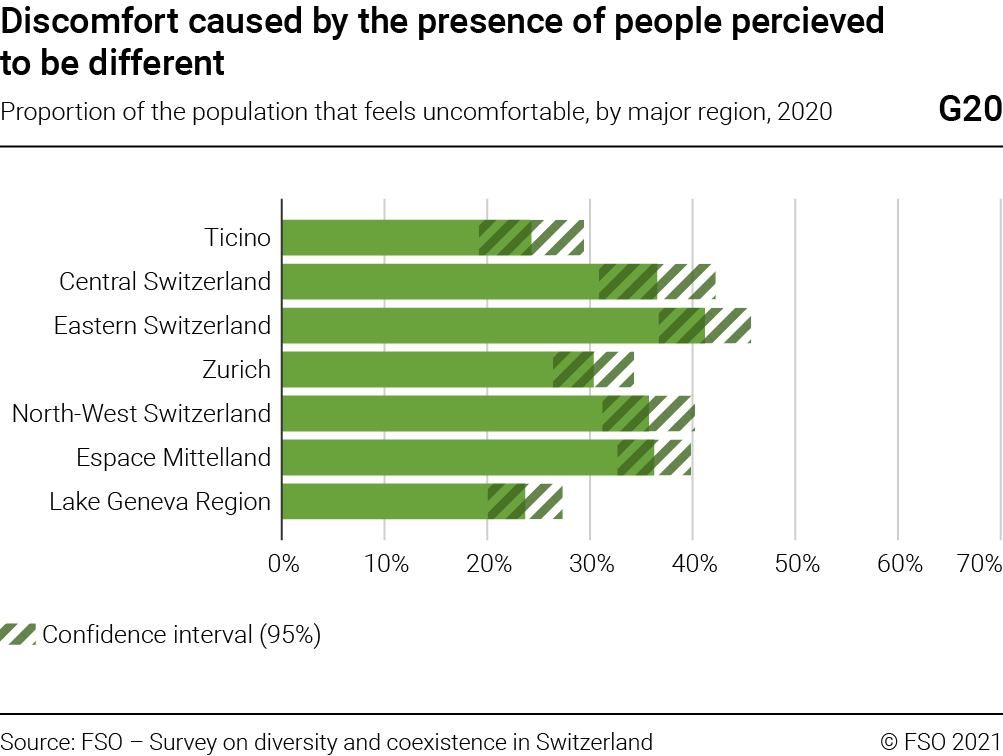
Attitudes towards diversity vary according to the major regions. The inhabitants of certain regions more often claim to feel discomfort in the presence of people perceived to be different (G20); this is the case in eastern Switzerland, central Switzerland, north-western Switzerland and in the Mittelland where 41%, 37%, 37% and 36% respectively of the population state a potential discomfort. The sense of discomfort is statistically significantly less common (24%) in the region around Lake Geneva than in the aforementioned regions. With respective rates of 30% and 24%, the regions of Zurich and Ticino also display a less prevalent sense of discomfort.
Opinions relating to foreign nationals and to the granting of more rights in their favour also vary from one major region to the next (G21). Regardless of the right in question (family reunification, automatic naturalisation or political participation), it is in central Switzerland that the rates of opposition to the granting of rights are highest (between 37% and 58%). On the other hand, rejection of the granting of rights is less widespread in the Lake Geneva area (between 28% and 34%).

With regard to general attitudes towards foreigners, without referring to their rights, similar trends can be observed in the regions, albeit with noticeable variations depending on the issue addressed (G22). The people of eastern Switzerland most readily agree that foreigners abuse the Swiss social benefits system (49%). The idea that foreigners are responsible for increasing unemployment in Switzerland is more widespread in Ticino than in the other major regions (35%). In comparison with the other regions, the feeling of insecurity on the streets linked to migration is weakest in Zurich and the Lake Geneva area (19% and 15% respectively compared to 26% in eastern Switzerland, central Switzerland and the Mittelland). Individuals living in the Lake Geneva area feel the least like “foreigners in their own country” (15%).

Due to the size of the survey sample, trends with regard to attitudes according to the major Swiss regions are not always statistically significant. We nevertheless note that people living in the Lake Geneva area display attitudes which are generally more favourable towards diversity and foreigners. Beyond the Lake Geneva area, indicators show that Zurich is also more open than the other major regions. Negative opinions are observed more frequently in eastern Switzerland, central Switzerland, in the Mittelland and in north-western Switzerland.
4.2 Language regions
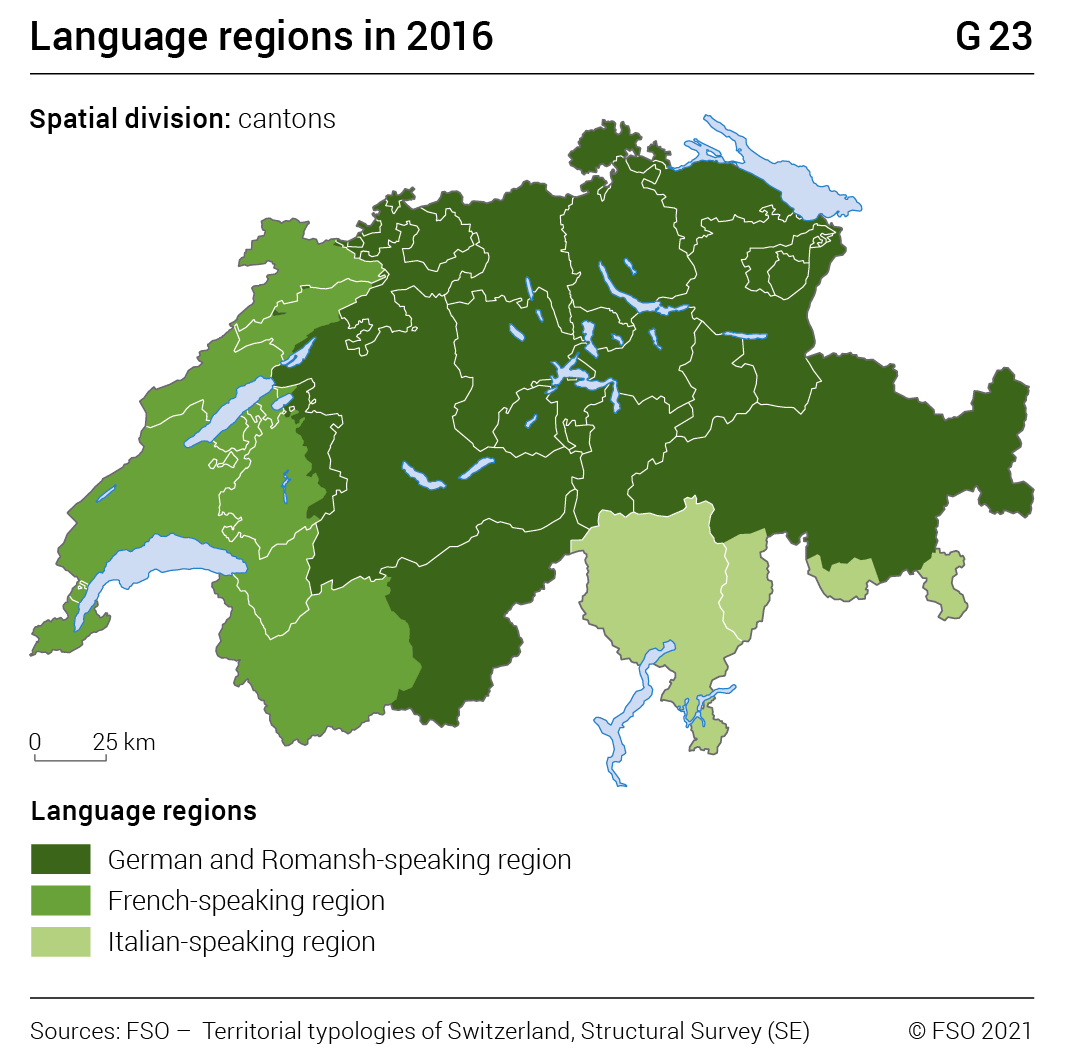
The language regions represent the oldest form of non-institutional regionalisation of Swiss statistics (G23). The Federal Statistical Office (FSO) demarcates areas where the majority of the population speaks German, French, Italian or Romansh according to federal population censuses FSO website: https://www.atlas.bfs.admin.ch/maps/13 .
According to the language regions in Switzerland, attitudes towards diversity and migration differ and the degree of openness of the population varies (G24). Analyse of the sense of discomfort shows that people living in German and Romansh-speaking Switzerland The two language regions are grouped together due to the size of the sample and the population numbers in the Romansh region. The Romansh language region cannot be analysed independently. feel the greatest sense of discomfort in the presence of someone with a different nationality, religion, language or skin colour from their own (37%). In comparison this figure falls to 24% in the French- and Italian-speaking regions.

With regard to granting more rights to non-nationals living in the country, the population in the German, Romansh and Italian-speaking regions are less open than that of the French-speaking region (G25). The gap between the latter region and the other regions is greatest with regard to the right to vote: 32% of the people living in French-speaking Switzerland are opposed to granting foreigners the right to political participation compared to 52% in German and Romansh-speaking Switzerland and Italian-speaking Switzerland. The same pattern can be observed with regard to automatic naturalisation of the 2nd generation. It is once again the people of French-speaking Switzerland who display least opposition, with a rate of 33% (compared to 43% in the other language regions).

As is the case for potential rights, the behaviours and roles of non-nationals are interpreted differently according to the language region (G26). With regard to the impact on children’s education, the risk of the system being abused, public insecurity and the feeling of not being “at home”, people living in French-speaking Switzerland feel less negatively affected by migration than people living in German and Romansh-speaking Switzerland. For example, in the French-speaking region, 11% of the population believe that the presence of foreign children in school is a hindrance to the education of Swiss children, compared to 28% in the German and Romansh-speaking region. The proportion of the population that believes that foreigners are responsible for increased unemployment is highest in Italian-speaking Switzerland (34% compared to about 22% in the other language regions).

Different attitudes according to the language regions are observed and a pattern can be distinguished between the indicators based on this regional variable. The people living in German and Romansh-speaking Switzerland are generally less open to diversity and foreigners while those in French-speaking Switzerland are shown to be more open. In the Italian-speaking language region, the main issue would appear to be the labour market, as the people living in this region display less openness on this issue.
4.3 Level of urbanisation
The typology of the level of urbanisation groups Swiss communes together according to their density (G27). It distinguishes highly populated zones, intermediate zones and sparsely populated zones.
Attitudes with regard to diversity and people of foreign nationality differ according to the level of urbanisation of the zones analysed. People living in more populated zones generally display greater openness than people living in the other, less populated zones. The sense of discomfort in the presence of people perceived as being different is less common in highly populated zones than in more sparsely populated zones (27% compared to about 35% and 38%) (G28). With regard to the discomfort caused by the presence of otherness in everyday life, no statistically significant difference can be observed between intermediate and sparsely populated zones.

A similar trend can be seen concerning the question of granting more rights to foreign nationals living in Switzerland (G29). Unfavourable attitudes towards granting rights are less common in highly populated zones than in less populated zones. Similar to the observations concerning discomfort, there is little difference between the attitudes in intermediate and sparsely populated zones. Regardless of the right in question, the same trend is observed.

Opinions relating to non-nationals living in Switzerland also vary according to the zone studied and its population density. Once again, negative opinions are less widespread in highly populated zones than in the other zones, where the prevalence is almost identical (G30). For example, people living in densely populated areas feel significantly less insecure on the streets than people living in sparsely populated areas (18% and 24% respectively). They are also less inclined to feel like foreigners in their own country (17% compared to 25%). With regard to the behaviours and roles attributed to non-nationals, people living in highly populated areas display more positive and open attitudes. In particular, fewer people in these areas feel that foreigners are responsible for increased unemployment in Switzerland (19% compared to about 26%) and that they represent a hindrance to the education of Swiss children (18% compared to about 26%).

Attitudes towards diversity and foreigners change noticeably and according to a clear pattern according to the level of urbanisation of the communes. People living in populated areas are more open while those living in intermediate or sparsely populated areas are more reserved. While the differences in percentage points are sometimes only small, they are almost always statistically significant, thereby confirming the existence of specific attitudes according to the different areas and their population density.
When interpreting these results, it should be taken into account that in urban and densely populated areas, there is a larger presence of the foreign population or people with a migration background. As shown in the previous chapter, (see sub-chapter 3.2.2), this population generally displays more positive attitudes.
4.4 Contacts with diversity
The results of sub-chapter 4.3 relating to the level of urbanisation tend to support the social science theory referred to as the “contact hypothesis” first put forward by Allport (1954) Allport, Gordon (1954): The Nature of Prejudice. Reading. Massachusetts: Addisson-Wesley Publishing Company. and echoed by Hewstone and Swart (2011) Hewstone, Miles and Hermann Swart (2011): Fifty-odd years of inter-group contact: From hypothesis to integrated theory, British Journal of Social Psychology, 50 (3). https://doi.org/10.1111/j.2044-8309.2011.02047 . According to this theory, openness towards the immigrant population increases with the intensity of contacts between endogroups and exogroups, as demonstrated in chapter 7 of A Panorama of Swiss Society (2020). We observe that densely populated areas, such as urban cores, are home to a more diverse population in terms of nationalities, countries of birth and languages. We can therefore assume that this mixed and cosmopolitan character of urban centres and their population density make them more conducive to encounters between different types of population. Based on this, we can postulate the existence of a link between the urbanisation variable and the variable of contact between different population groups.
To check these links, a variable relating to contacts was introduced into the 2020 survey on diversity and coexistence in Switzerland (VeS). While it is still to prove its worth in the long run, it has revealed trends in line with the hypotheses of contact theory. People who state that they have no contact with people of different backgrounds more often feel discomfort in the presence of diversity than people who have such contact in their everyday life. Furthermore, compared to people who have frequent contacts, those with no contact are less willing to grant more rights to non-nationals living in the country. Predictably, their general opinions about foreigners are less favourable than the opinions of people with contact.
Analysis of the data from the 2017 diversity module concerning the issue of racism against Black people has highlighted links between attitudes towards Black people and frequency of contact. The general attitude of the population towards racism against Black people varies according to the frequency of everyday contact with the Black populations. People who state that they are often in contact with the minority are significantly more likely to admit the existence of racism towards this population (18%) than those who have little or no contact (11%).
There is, at first glance, a link between attitudes and contact, but this merits more detailed analysis using additional empirical data. For this factor more than others, the direction of causality must be investigated: does contact favour openness or does openness give rise to contact? Considered as an independent variable within the framework of the present analysis, other avenues should be explored in the future. The nature of the contact should also be described more precisely. Is the impact of contact different when it is chosen and when it is “imposed”? The 2022 and 2024 surveys on diversity and coexistence in Switzerland (VeS) will provide an empirical basis to endeavour to answer these new questions. They will help highlight the relations between demographic, regional and contact factors and the attitudes of the population towards diversity.