The results presented here are limited to people living in private households aged from 16 to 64. This limit corresponds to the data available and to the ages at which the issue of equality for persons with disabilities is most sensitive (in particular, access to education and to the labour market). In this age group, the proportion of people with disabilities among the population living at home totals 19% (severely limited people: 4%).
3.1 Education
Access to education and training is a basic human right. This concerns children and young people with disabilities (basic education) but also adults (continuing education and professional retraining).
In the school year 2017/18, 42 101 pupils received reinforced special education measures, i.e. 4% of all pupils in compulsory education. The majority (22 266) were integrated into a standard class, whereas 17 304 received separate schooling in a specialised school.
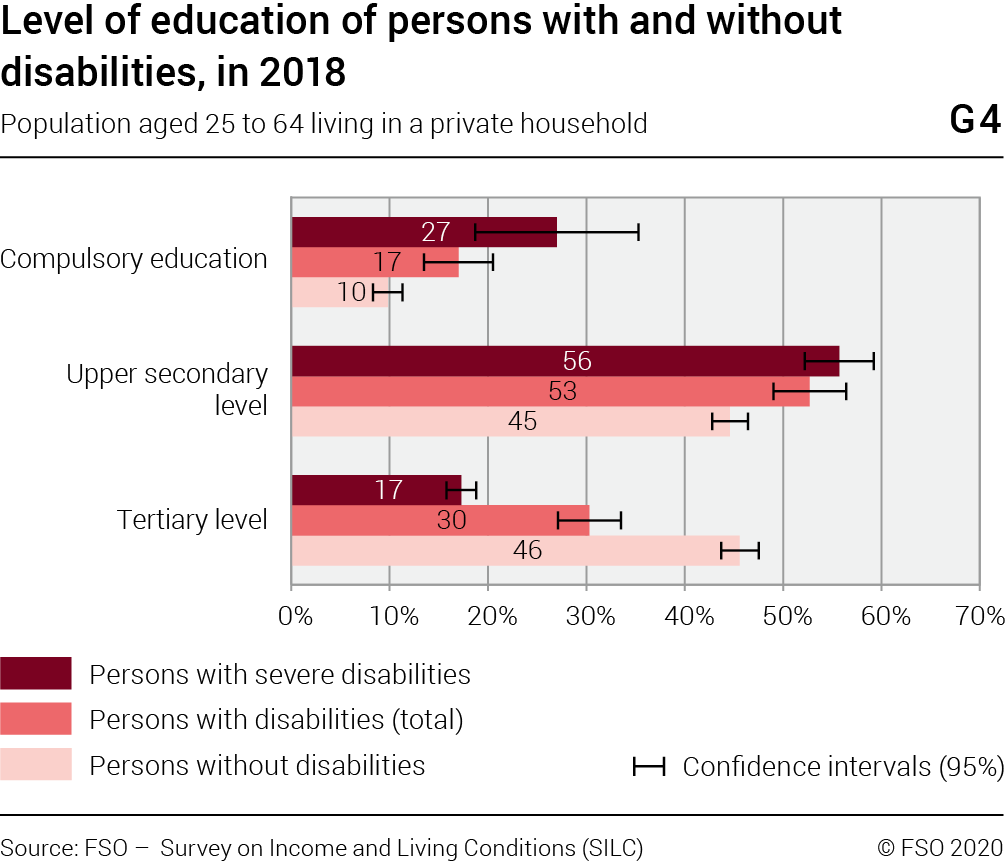
People with disabilities have a lower level of education than the rest of the population. But disability is not the only reason for this difference. As the disability often appears after the age at which people complete their initial education, the relation between education and disability can be reversed: education influences the types of occupation carried out; different occupations imply different risks for a person’s health.
As is the case for other groups with a low level of education, persons with disabilities are less likely to engage in further education.
3.2 Professional activity
Labour market participation plays a key role in the equality of people with disabilities, featuring prominently in the Disability Discrimination Act. This participation enables persons with disabilities to provide for themselves through gainful employment. It is also a way for people with disabilities to put to good use their skills and ability to work, to engage with other people, to create a social and professional identity and to fully take part in our society where adults’ social roles are mainly organised around productive and paid work.

Among persons with disabilities of working age (aged 18–64), two out of three participate in the labour market: 63% have a job and 5% are unemployed, i.e. 68% of economically active persons (figures for 2018). These figures show a high degree of involvement of persons with disabilities in working life. Even among people who are severely limited, just under half are economically active (46%). This involvement is, however, smaller than that of people without disabilities (82%).
Among people with disabilities who have a job, 40% work part-time (less than 36 hours per week) whereas only 27% of people without a disability do so (figures for 2018). The working conditions of people with disabilities appear to be comparable with those of people without disabilities.
Alongside ordinary labour market participation (known as “primary market”), many people with disabilities carry out productive work in protected structures adapted to their abilities (known as “secondary market”).
3.3 Financial situation
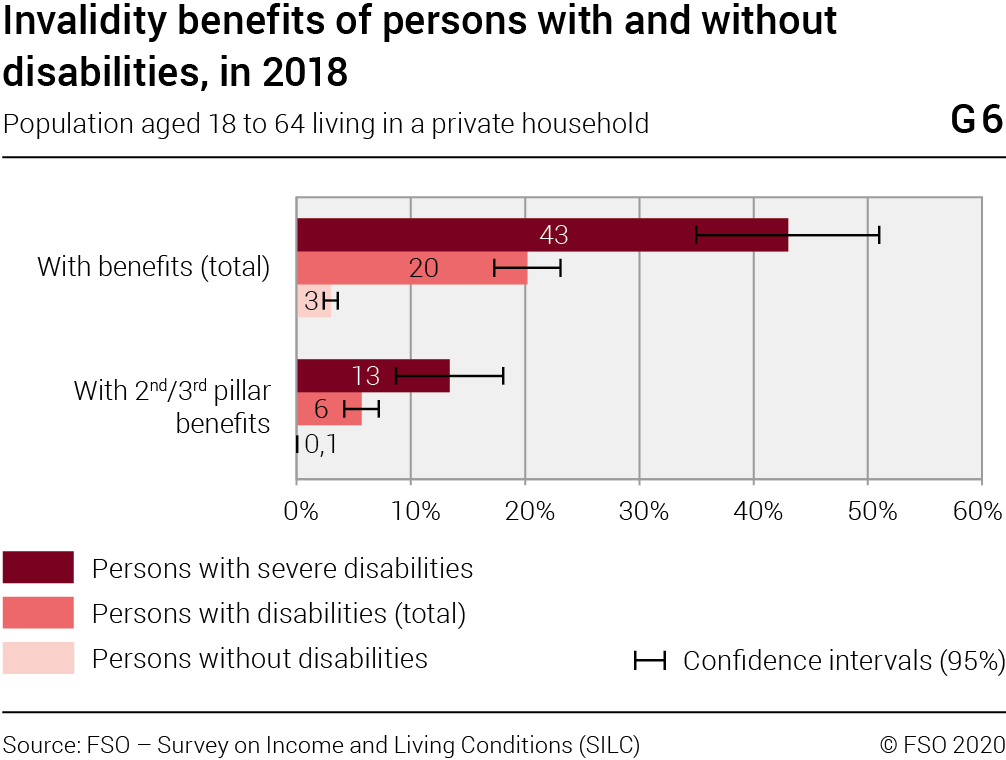
4% of 18 to 64 year-olds living in a private household receive an invalidity insurance (IV) pension. Logically, many more people with disabilities receive regular benefits from the IV (pension or daily allowances, etc.) than persons without disability. However, this concerns only a minority of persons with disabilities (2018: 20%), even among those who say they are severely limited (43%). This finding confirms the difference between disability and invalidity. Among people with disabilities receiving IV benefits, a little more than half also receive benefits from pension funds (2nd pillar) or, more rarely, from a private insurance (3rd pillar).
Overall, women with disabilities are less likely to receive invalidity benefits than men with disabilities. This gap, however, tends to narrow after several years.
3.4 Subjective well-being
The measurement of satisfaction with regard to equality for persons with disabilities is important. It enables areas of life to be identified in which the objective differences between persons with and without disabilities have an impact on quality of life or where improvement is most needed.
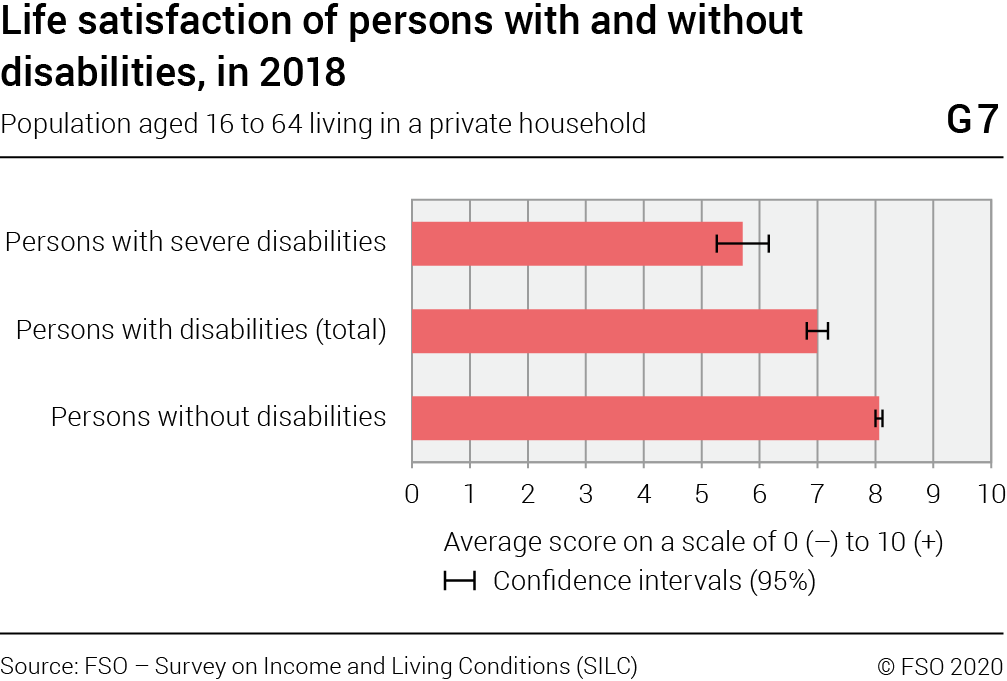
People with disabilities are less satisfied with their life in general than the rest of the population. This holds true in almost all areas of subjective well-being, but in particular in regard to health, financial situation and leisure-time activities.
3.5 Discrimination
Universal rights grant every human being the protection of their fundamental rights and freedoms. They guarantee the principle of equality in dignity and rights, free from poverty and any form of violence and discrimination.
According to the Diversity and coexistence in Switzerland survey 2018, 4% of the permanent resident population aged 15 to 88 said they had been victims of discrimination in Switzerland due to a disability during the past five years.
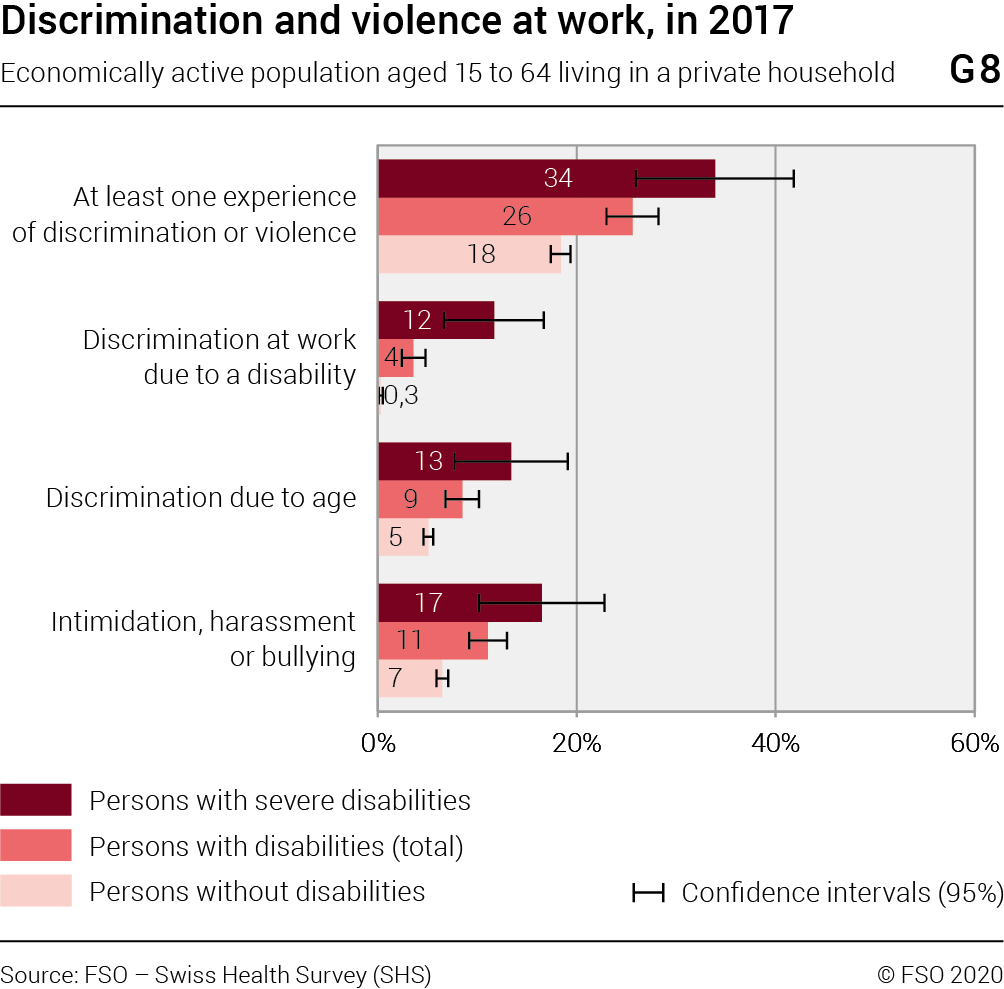
Discrimination is particularly manifest in the world of work. According to the Swiss Health Survey 2017, 4% of persons with disabilities aged 15 to 64 said they had been discriminated against at work in the past year due to a disability. Among people with a severely limiting disability, this rate was 12%.Irrespective of a disability, discrimination at work is most likely to take the form of bullying, harassment or intimidation.
3.6 Mobility
Getting about is not always easy for persons with disabilities. Their difficulties are obviously related to their disability (paraplegia or blindness) but also to the built or technological environment (inaccessible bus, lack of audible information or floor markings, etc.). The Disability Discrimination Act aims to remove these environmental barriers, in particular in the area of public transport.
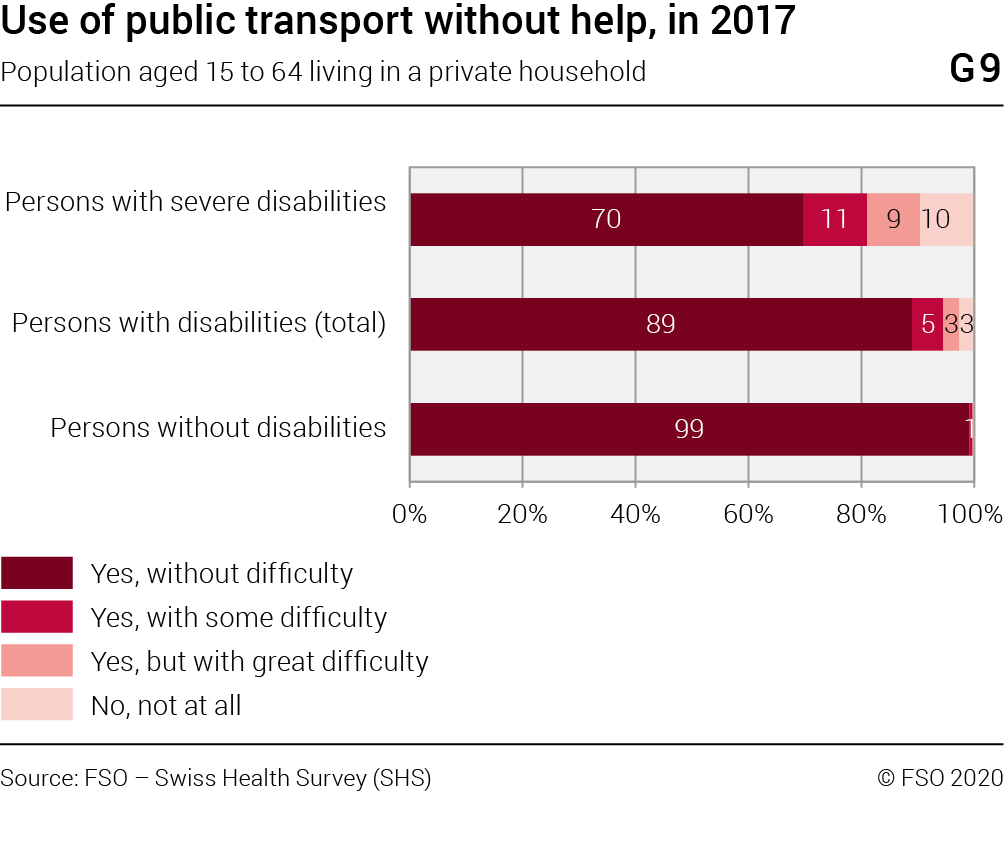
The vast majority of persons with disabilities (89%) say they can use public transport independently and without difficulty. Only certain disabilities lead to reduced mobility. Only 5% say they have some difficulties, 3% a great amount of difficulty and 3% cannot use bus and trains at all without help. Among people with a severely limiting disability, these percentages are even higher: In all, three in ten have at least some difficulty in getting about alone on public transport and one in 10 cannot do so at all.