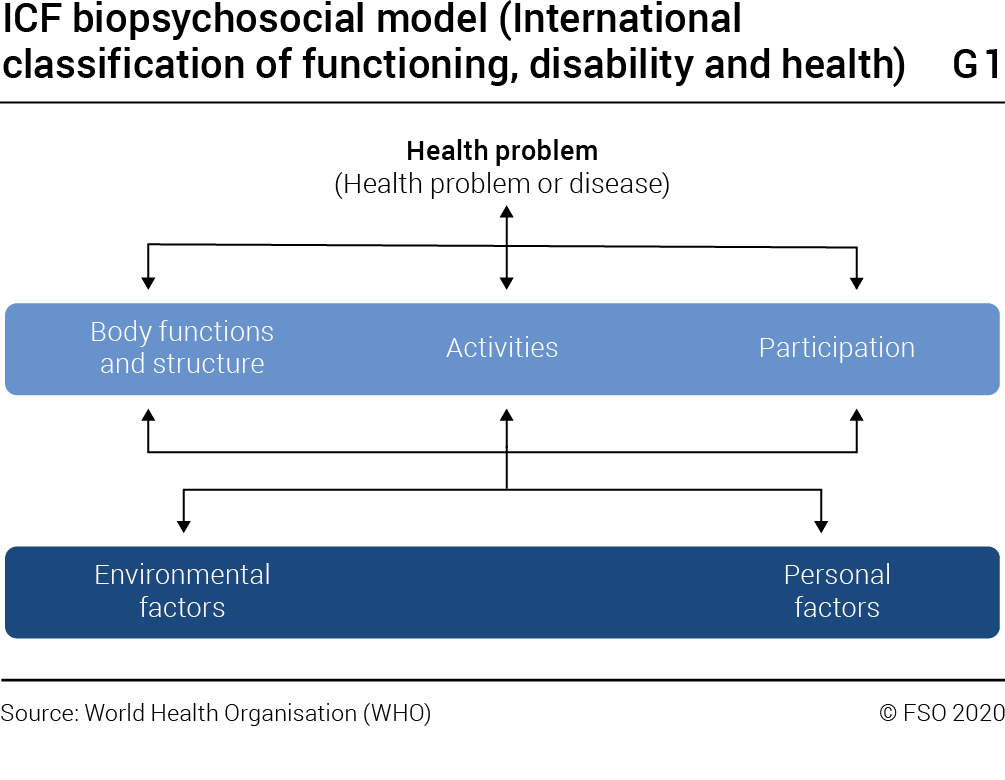
Disability is a complex, multifaceted phenomenon. It takes many forms and its consequences vary widely depending on:
– The nature of the disorder or of the biological particularity from which the disability arises (physical deformity, mental illness, functional difficulty, etc.).
– The intensity of this disorder or particularity and the social reaction it causes (degree of disability)
– Social concepts defining disability in general and attitudes towards people with a disability (prejudice, policies for the assistance or monitoring of persons concerned, etc.).
– Other aspects also play a role, such as the period in the cycle of life in which the disability appears and the time that has passed since it appeared, whether the disability is visible or not, or the physical and technological environment in which the persons concerned live (adapted pavements, automatic doors, etc.)
According to the World Health Organisation (WHO), disability exists when a health condition affects the body’s functions or structures (impairment), the capacity to execute activities (activity limitation) or performance in the social environment (participation restriction). According to the World Health Organisation (WHO), disability exists when a health condition affects the body’s functions or structures (impairment), the capacity to execute activities (activity limitation) or performance in the social environment (participation restriction).
This notion is based on an interactive model (see 1.3). It proposes a synthesis of the individual model (1.1) and the social model (1.2); these two models strongly influenced the politics of disability in the 20th century – and official statistics. Other models, such as those of a religious nature, exist or have existed in the past.
1.1 The individual model (or medical model)
The individual model appeared after the First World War and is based on a biomedical approach. Disability is defined as a person’s “physical, psychological or mental impairment” that results in the limitation of their social participation. This model follows a logic of cause and effect: an illness or trauma causes impairment to the organism resulting in the inability to do certain things – this leads to a social disadvantage or disability. Thus the disability is obviously the result of the individual’s impairment. The proposed interventions are mainly medical and are aimed at eventually curing the person or at least rehabilitating them for society as it exists for “abled people”.
1.2 Social model
As a reaction to this very medical vision of disability, from the 1960s onwards different movements arose in which people with disabilities developed a strictly social perspective of disability. This gave birth to the social model which considers disability as the result of society’s inability to take account of its members’ differences. Thus the origin of the disability is external to the individual. The type of interventions proposed changes accordingly: the social approach dismisses the ideal of a cure and prefers to work on the abilities the person does have in order to improve their independence in everyday life. This model also advocates the removal of physical and social barriers. This means adapting the environment and services so that persons with physical or mental disabilities can access them and use them.
1.3 Interactive models
A third type of model has emerged in reaction to the limited perspectives that the two traditional models may offer. The WHO’s new international Classification of Functioning, Disability and Health (CIF or ICIDIH) attempts to take into account individual and environmental aspects in its description of disability. The Human Development Model (HDM), which has been developed since the 1980s by Patrick Fougeyrollas and his team at the International Network on the Disability Creation Process in Quebec, focuses on the interaction between the various factors leading to a disabling situation. These new approaches aim to be inclusive and dynamic in an attempt to go beyond the individual determinism of the medical model or the external determinism of the social model.