Temporary employment
Source: FSO – Swiss Labour Force Survey (SLFS)
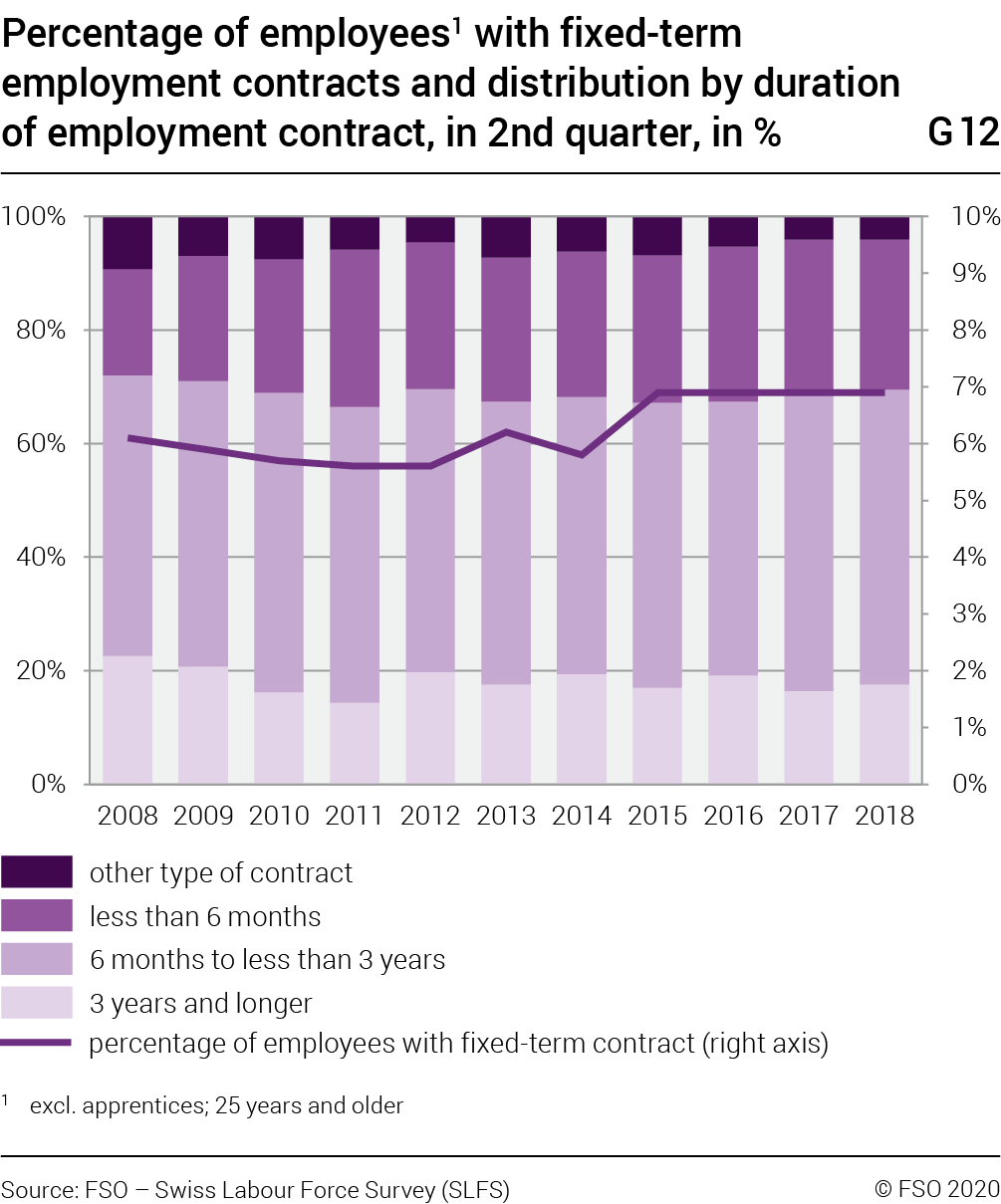
In the 2nd quarter 2018, the percentage of employees with fixed-term contracts was 6.9% 25 years or older , which represents an increase of 0.8 percentage points compared with the 2nd quarter 2008. In 2018, 26.4% of the 236 000 fixed-term employees were working on a contract due to expire within five months. A further 52.0% were on a contract lasting from six months to under three years. Some employees on a fixed-term contract found their job through a private employment agency which also pays their salary. In 2018, 1.2% of employees (with permanent residence in Switzerland) were in such a situation.
Length of service
Source: FSO – Swiss Labour Force Survey (SLFS)
The majority of employed persons 25 years or older remains loyal to their company for a long time: In 2018, 58.1% of employed persons had been working for five or more years for the same company (2008: 61.1%) and another 28.4% had been working there for one to less than five years (2008: 27.6%). Only 13.4% had worked in the same enterprise for less than one year (2008: 11.2%).
Self-employed persons without employees
Sources: FSO – Swiss Labour Force Survey (SLFS), Business demographic statistics (UDEMO)
Self-employed persons without employees can be exposed to increased financial risk as well as precarious working conditions, particularly at the beginning of their self-employed activity. This is reflected in the survival rate of new businesses. 52.7% of the newly founded enterprises in 2013 employing one person were still active four years later (2017). The corresponding survival rate of enterprises with 10 employees or more was 69.0% in 2017.
In the second quarter 2018, 16.5% of employed persons were self-employed (2nd quarter 2008: 17.5%) and 8.1% of employed persons were self-employed without employees (2nd quarter 2008: 8.6%). Consequently, approximately one in two self-employed persons works alone (49.2%).

Perceived job security
Source: FSO – Swiss Health Survey (SHS)
The overwhelming majority of employed persons feel that their job is secure. In 2017, 43.8% were not at all afraid and a further 41.1% were not very afraid of losing their job (2007: 42.9% and 44.6% respectively). Almost half of respondents (45.4%) said that if they were to lose their job, they would find a similar job very or quite easily (2007: 40.0%). Survey question: “Are you afraid of losing your current job?” and “If you were to lose your current job/apprenticeship: how easy would it be for you to find a similar job?”


Social benefits: Unemployment
In Switzerland, female employees aged 18 to 63 and male employees aged 18 to 64 are insured on a compulsory basis against unemployment. Should an employed person lose his or her job and fulfil certain conditions, he or she is entitled to a daily allowance. Self-employed persons, however, are generally not insured against unemployment.
Social benefits: Old-age provision
Source: FSO – Household Budget Survey (HBS)
The old-age provision in Switzerland is based on a three-pillar system. The 1st pillar includes, amongst other provisions, the old-age and survivors insurance (AHV/AVS), to which contributions are compulsory for all 18 to 63-/64 year-old employed persons. It aims to cover basic needs in old age.
Occupational pension plans come under the 2nd pillar. In the event of old age, disability or death this acts as a complement to the first pillar. In principle, contributions are compulsory for employees who earn more than a stipulated minimum annual wage (2019: CHF 21 330). It is optional for self-employed persons. The purpose of the occupational pension plan is to enable persons to continue with the same standard of living after the onset of old age, disability or death.
In 2017, 90.6% of employees and 16.4% of self-employed persons Extrapolation based on fewer than 50 observations. The result should be regarded with great caution (concerns 2007 and 2017). paid 2nd pillar contributions. employed population aged between 25 and normal retirement age in accordance with AHV/AVS In 2007, these percentages were 87.8% and 21.3% respectively.
Voluntary contributions can be paid into the 3rd pillar (private pension) to complement the 2nd pillar occupation pension plan. This is divided into fixed and flexible pension plans (pillars 3a and 3b). Access to the fixed pension plan is usually blocked until the start of retirement main exceptions: Becoming self-employed, buying own property, emigration . Pension plan holders can decide the amount of the contributions themselves, up to a maximum amount. With flexible pension plans, the insured person can have access to the amount saved at any time, as the 3b pillar is not tied to a specific period of time.
In 2017, 56.9% of self-employed persons and 55.8% of employees paid contributions to the 3a pillar employed population aged between 25 and normal retirement age in accordance with AHV/AVS . This corresponds to an increase of +14.4 and +10.2 percentage points compared with 2007.

