Human activities generate waste and other emissions that enter the air, soil or watercourses. The higher the emissions, the greater the impact on the environment.

Nitrogen oxides (NOX) are released during the combustion of fuels, with motorised transport being the main source. NOX and volatile organic compounds (NMVOC) are precursors for the formation of ozone (O3) and particulate matter. NOX together with ammonia (NH3) lead to the acidification and the over-fertilisation of natural ecosystems such as fens and forests. Emissions of most air pollutants in Switzerland have decreased since the 1990s.
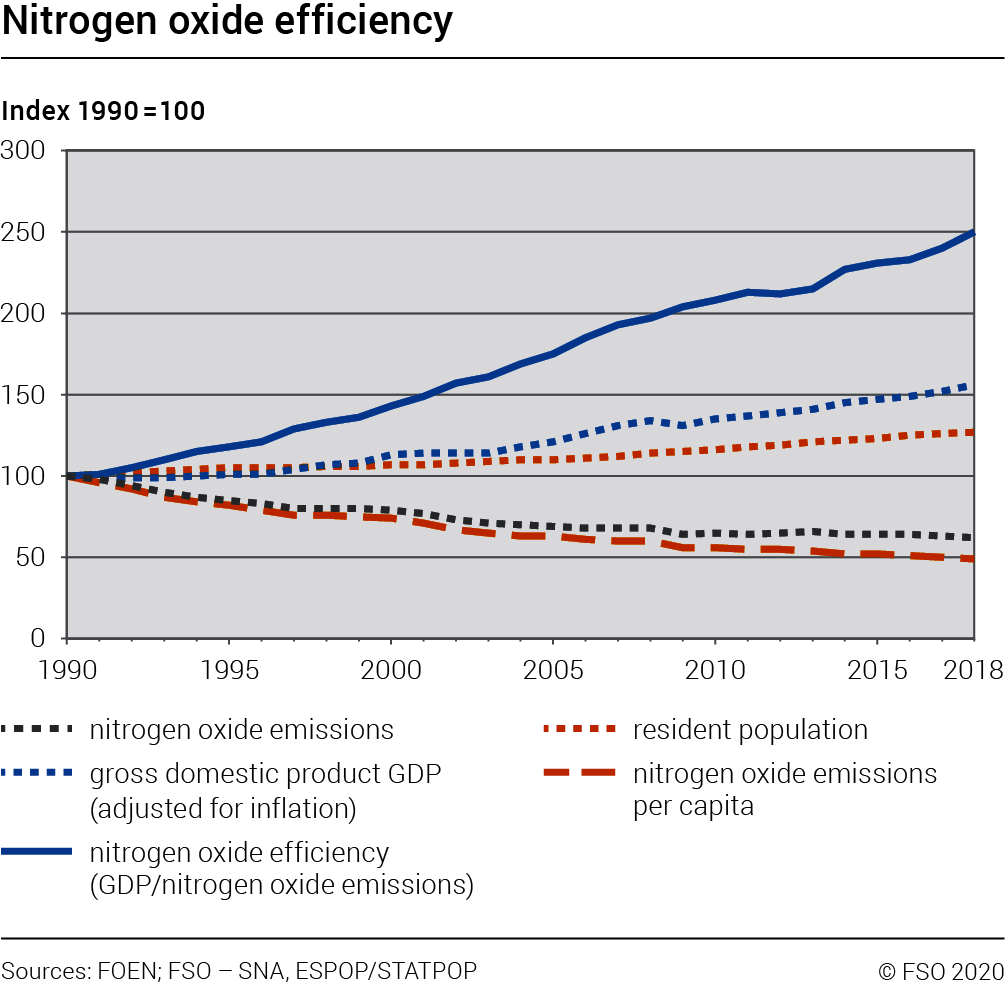
Although the gross domestic product (GDP) has grown since 1990, nitrogen oxide (NOX) emissions have fallen, so that nitrogen oxide efficiency has increased. This means that in 2018, less NOX was emitted per Swiss franc generated than in previous years. The resident population also increased between 1990 and 2018. Consequently, less NOX is released per capita today than several years ago.

Due to greenhouse gas emissions, humans intensify the natural greenhouse effect and influence the climate in this way. The majority of these greenhouse gas emissions come from the burning of fossil energy carriers. The greenhouse gas footprint corresponds to the total greenhouse gas emissions caused in Switzerland and abroad to cover final domestic demand. In 2018, Switzerland’s greenhouse gas footprint was 113 million tonnes of CO2 equivalents, 66% of which was emitted abroad.
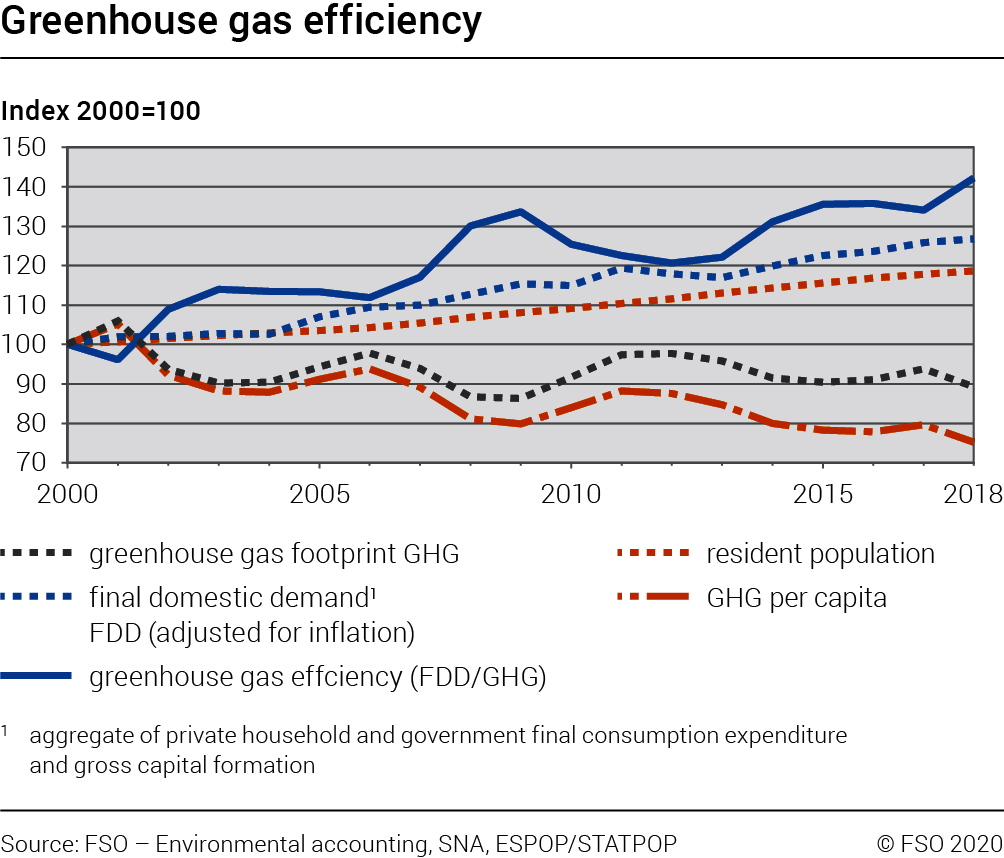
Greenhouse gas efficiency is the ratio of final domestic demand to the greenhouse gas footprint. Final domestic demand is the aggregate of private household and government consumption expenditure as well as gross capital formation and changes in inventories. As this has risen since 2000, and the greenhouse gas footprint has remained fairly stable, the result has been an increase in greenhouse gas efficiency. The resident population has also grown since then; consequently the greenhouse gas footprint per person has declined. In 2018 it was 13 tonnes of CO2 equivalents.

Nitrogen (N) is used as a fertiliser in agriculture. From the excess amount, a part is released into the air as ammonia (NH3) and another part is leached as nitrate (NO3) into groundwater. In the last ten years, the nitrogen surplus of agricultural areas has been around 100 000 tonnes per year on average.
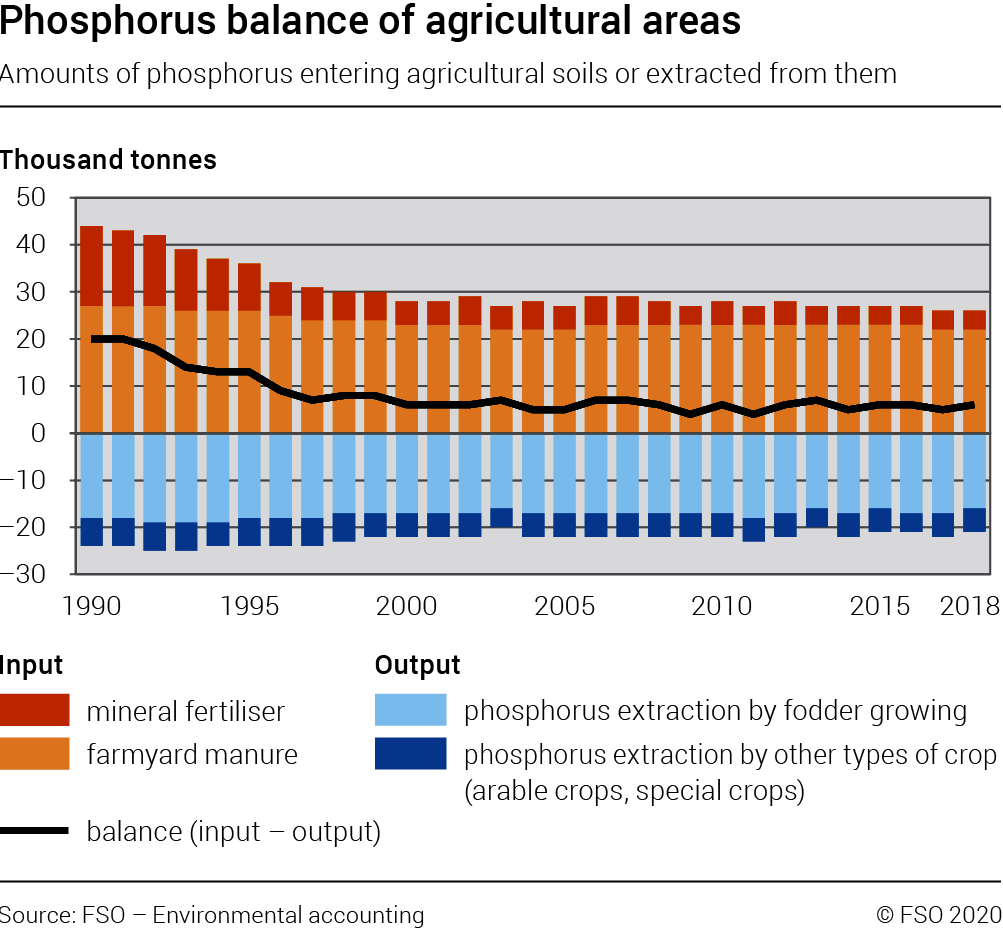
Phosphorus (P) is one of the main nutrients of plants and is used in agriculture as a fertiliser. Excess phosphorus can enter surface water through soils and stimulate algae and plant growth, particularly in lakes. When this biomass dies off and decomposes, there may be a shortage of oxygen and thus a disruption of the ecological balance. In the last ten years, excess phosphorus of agricultural areas has been around 5500 tonnes per year on average.

In 2018, roughly 6 million tonnes of municipal waste was generated in Switzerland. Around 52% of this was separately collected and recycled. In 1990, the corresponding share was 29%. The remainder was burnt in waste incineration plants or (before 2005) burnt or land-filled. The heat generated by incineration is used for district heating or the production of electricity.

The increase in municipal waste since 1990 is roughly in line with the gross domestic product GDP: in 2018, roughly the same amount of waste per Swiss franc generated was caused as in 1990. However, municipal waste has increased more considerably than the resident population: in 2018, municipal waste per capita was 705 kg, nearly 100 kg more than in 1990. This does not, however, include waste that is generated abroad during the manufacture of imported goods.
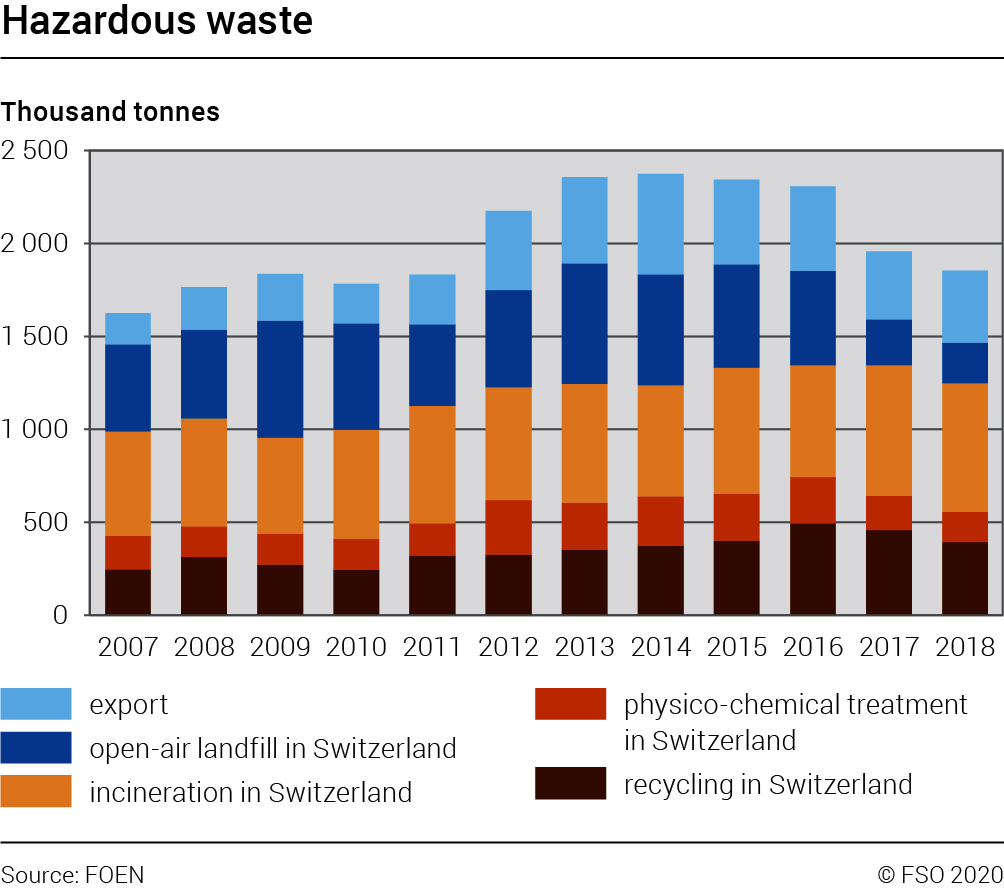
Hazardous waste requires special technical and organisational measures for disposal due to its composition and characteristics. Of the approximately 1.9 million tonnes of hazardous waste generated in Switzerland in 2018, 79% was recycled, treated, burned or landfilled, 21% was exported. The increase a few years ago is mainly due to contaminated matter excavated during the clean-up of brownfield sites.