Education is an important mean by which gender equality can be achieved. People with a good education usually have more opportunities to shape their own life and to cope with new challenges in the family, their profession and in politics.
1.1 Educational attainment
Educational differences between the sexes have been narrowing over time. The proportion of women without post-compulsory education has decreased. Both the shares of women and of men with a university education have increased markedly. The proportion of women with a higher vocational training has also progressed. This trend towards gender parity to the point of a reversal of the situation with regard to the highest level of education completed is clearly shown among the 25 to 34 age group. More women than men in this age group are graduates of a higher education institution.

1.2 Completed education
Long-term trends in educational attainment are also reflected in the education and qualifications of subsequent generations.
The upper secondary first qualification rate – meaning the percentage of young people who obtained a first qualification at upper secondary level after having completed compulsory education – shows that more women completed an initial post-compulsory education by the age of 25 than men (94% compared with 89%). The proportion of women who have completed general education is higher than that of men. However, the opposite is true for the qualification rate in vocational training.

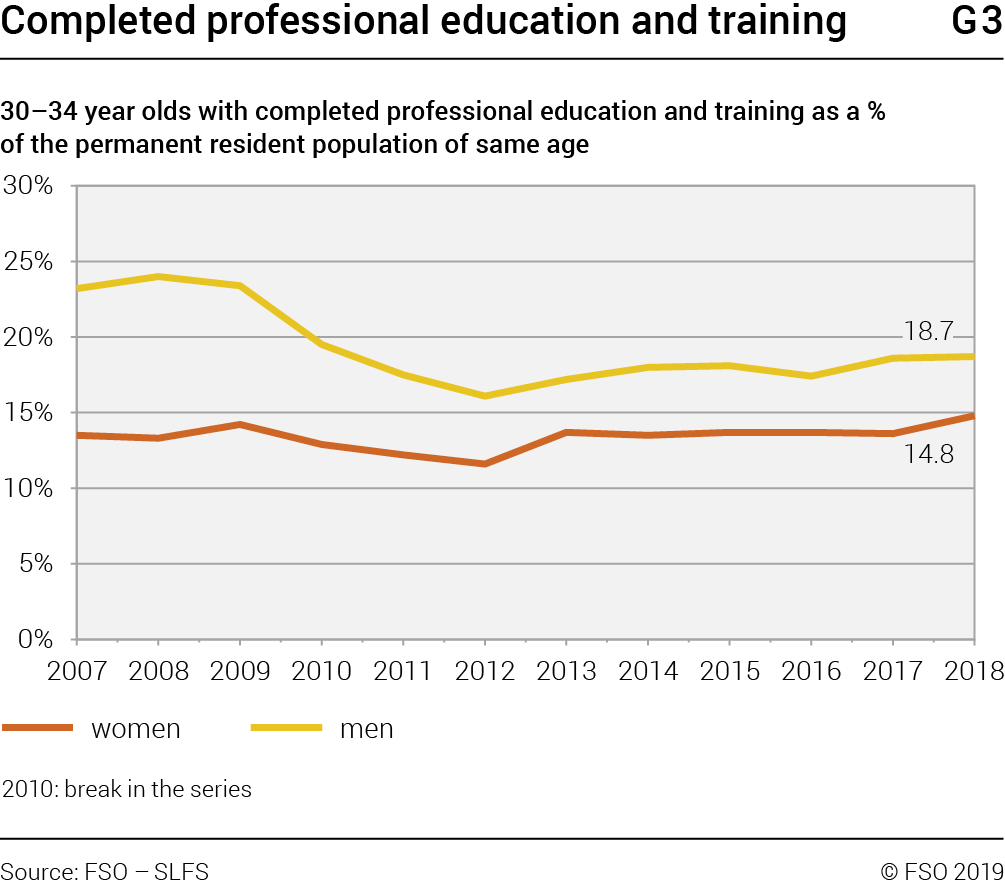
Also at tertiary level more men than women complete professional education and training. In recent years, women have caught up with and overtaken men in graduation rates from higher education institutions.

1.3 Career and study choices
Career and study choices are gender specific. Young men often choose technical careers and degree programmes such as engineering, manufacturing and construction, and are more likely to do so than young women. In contrast, young women often opt for vocational education and degree programmes in the area of health and welfare, and are more likely to do so than their male counterparts.
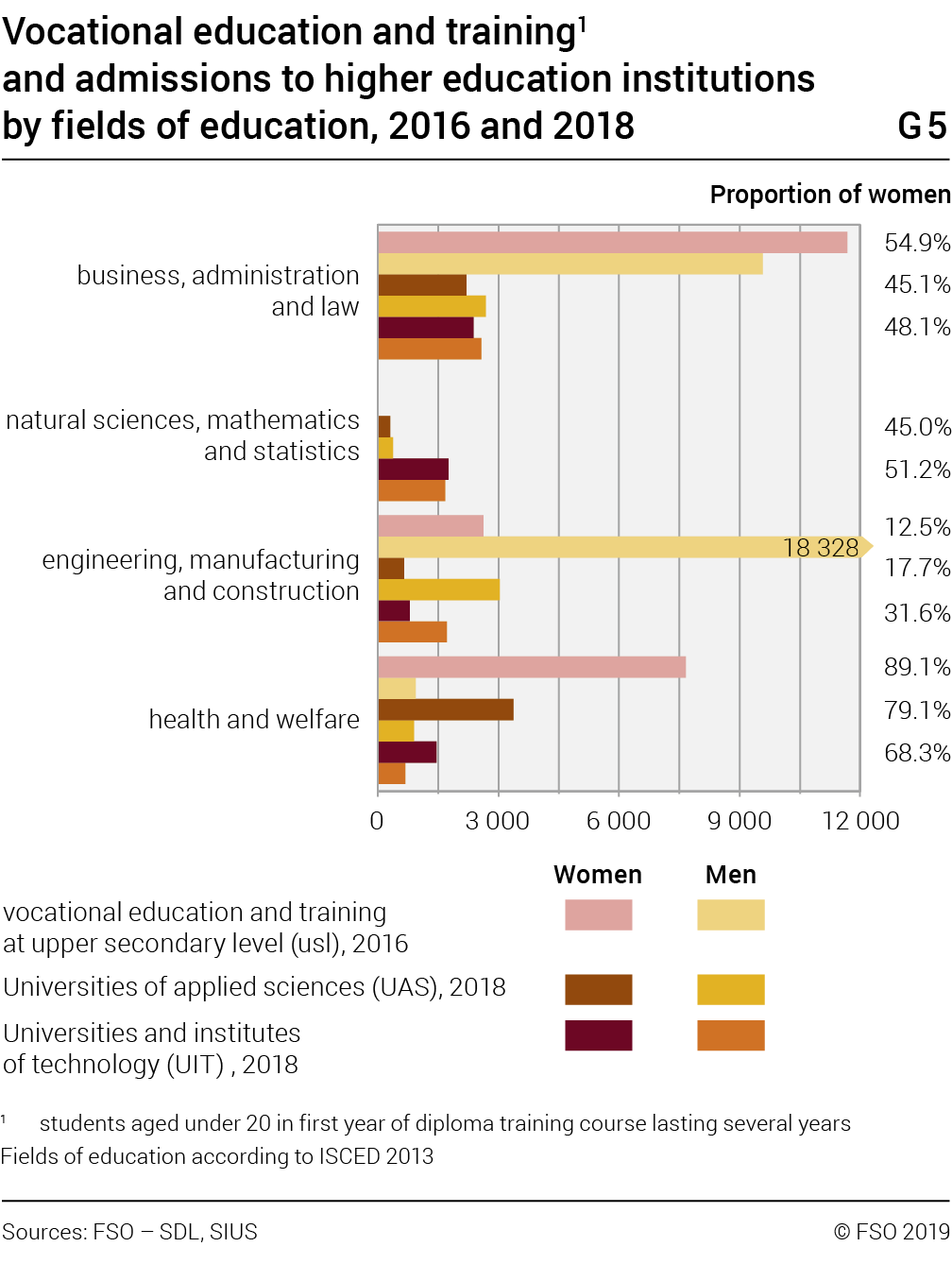
The gender-specific nature of career and study choices is only changing slowly. It has become less rigid over the past two decades. Young women are more likely than in the past to choose male-dominated fields of study as for example natural sciences, mathematics and statistics as well as engineering, manufacturing and construction. Also young men are more likely than before to decide on a female-dominated training or programme such as those in the field of health and welfare at upper secondary level and in the field of education at higher education institutions.
1.4 Teaching staff
The higher the grade, the smaller the proportion of women among teachers. Teaching at primary level 1–2 is an almost exclusively female domain; at university the ratio is inverted. It should however be emphasised, that women are represented in greater numbers among university staff than they were in the past.

1.5 Scientific career
The journey of women embarking on a scientific career can be compared to a leaky pipeline. Within higher education institutions, in particular, the number of women declines the higher up the academic career ladder one climbs. Despite the feminisation of the student population in the past years, men are in the majority from the doctorate stage on. In 2016, barely a quarter of researchers at the top of the academic ladder were women.
