

Reasons for migration and conditions upon arrival: differences by nationality groups
Why do people migrate to Switzerland? What are their future plans? What were their conditions upon arrival in Switzerland? Do differences exist depending on the nationality of migrants?
There are many causes of migration. Whether these are political, economic, social or climatic, they are often closely intertwined. For this reason, it is important to understand why populations undertake international migrations in order to work on their causes. The plans that migrants develop for the future have an impact on the host society. How long do they plan to stay in Switzerland for? Do they wish to return to their country of origin or do they plan to migrate to another country? What are the main reasons why migrants wish to leave Switzerland?
Since 1998, the Swiss Labour Force Survey (SLFS) has periodically conducted “Migration” modules on the situation of migrants and their descendants. The last two data collections are from 2014 and 2017. A new “Migration” module is planned for 2021.
After their arrival in Switzerland, migrants are faced with the challenge of integrating into social and working life. Not everyone enjoys the same starting conditions such as in terms of recognition of their diplomas or language skills. They face different obstacles in accessing education and training and the labour market. Based on the results of the “Migration” module of the Swiss Labour Force Survey (SLFS) from 2017 or 2014 Where the variables were not collected in 2017, the results from 2014 are presented. (see box), this publication explores the links between the stakeholders involved in the migration process by focusing on the topics of motivations or issues of migration and the conditions for migrants upon their arrival in Switzerland. The publication will first of all focus on the main reasons for the last migration but will also consider migrants’ future plans. The conditions upon arrival are analysed from three different angles: education and requests for equivalence of foreign qualifications, employment, and language skills.
The questions of motivations for migration and conditions upon arrival are discussed with a focus on the differences between nationalities, broken down by political and geographical subgroups.
Population by nationality
By definition, the permanent foreign resident population includes any person who lives in Switzerland but does not hold Swiss nationality. It includes all foreign nationals who hold a residence permit for a minimum duration of 12 months or who have resided in Switzerland for a total of at least 12 months (Permit B/C/L/F/N or FDFA permit [international civil servants, diplomats and members of their family]). This concept of the permanent resident population is used in the Population and Households Statistics (STATPOP). In the SLFS, diplomats and international civil servants and persons in the asylum process are nonetheless not taken into consideration.
At the end of 2017, 1.6 million foreign nationals born abroad and aged 15 years or older lived in Switzerland. This is the reference population in the analyses carried out in this publication. They represent 22% of the permanent resident population aged 15 or older. This share is the result of different waves of migration, a restrictive naturalisation policy, a high birth rate and a low mortality rate among the foreign population. The low mortality rate among this population is mainly explained by naturalisations and returns to the country of origin.
The majority of foreign nationals born abroad aged 15 or over residing in Switzerland on a permanent basis come from Europe. The 1 070 000 citizens of EU28 and EFTA member countries made up the main foreign community in 2017, i.e. 66% of the total number of foreign nationals born abroad aged 15 or over. The remaining balance was made up of 544 200 foreign nationals mainly originating from:
– other European countries that are not members of the EU28 and EFTA, i.e. 263 200 persons (16%);
– other countries in the world, i.e. 279 500 persons (17%);
– as well as 1500 individuals who cannot be attributed to a country (0.1%).
Reasons for and issues of migration
The following section presents the main reasons for people migrating to Switzerland. It also examines whether these reasons vary depending on the nationality of migrants. The second part also covers the future plans of migrants. How long do they wish to stay in Switzerland for? Why do they plan on leaving Switzerland? Do they wish to return to their country of origin or to migrate to another country? These results are systematically broken down by migrants’ nationality.
Main reason for migration
In 2017, 43% of the permanent resident population aged 15 to 74 and born abroad said that they immigrated to Switzerland for family reasons. These are persons who said that they had migrated to Switzerland to start a family or to join or rejoin their family. 32% of the above-mentioned population came to Switzerland for professional reasons. The next two reasons mentioned most often were asylum (6%) and study (5%). There is no significant difference between the last two reasons. 12% cited other reasons such as the quality of the health system, tax reasons and social networks in Switzerland (not including relatives).

The main two reasons for migration to Switzerland vary by nationality. The observed population is of foreign and Swiss nationality. The results for persons holding Swiss nationality are not, however, presented in this publication apart from the length of stay in Switzerland and the place of education and training because the figures are difficult to interpret. Born abroad, these Swiss nationals have mainly obtained Swiss nationality by naturalisation and this certainly took place after migration. Citizens from EU28 and EFTA countries mainly migrate to Switzerland for professional reasons (43%), whereas other immigrants tend to come to Switzerland for family reasons (roughly 55%).
Duration of stay
In 2017, 63% of the permanent resident population aged 15 to 74 who were born abroad intended to remain in Switzerland for good. 10% planned to remain at least 5 years, while 3% planned to leave Switzerland in less than 5 years. These last two percentages are nonetheless not significantly different. 20% did not have any future plans.
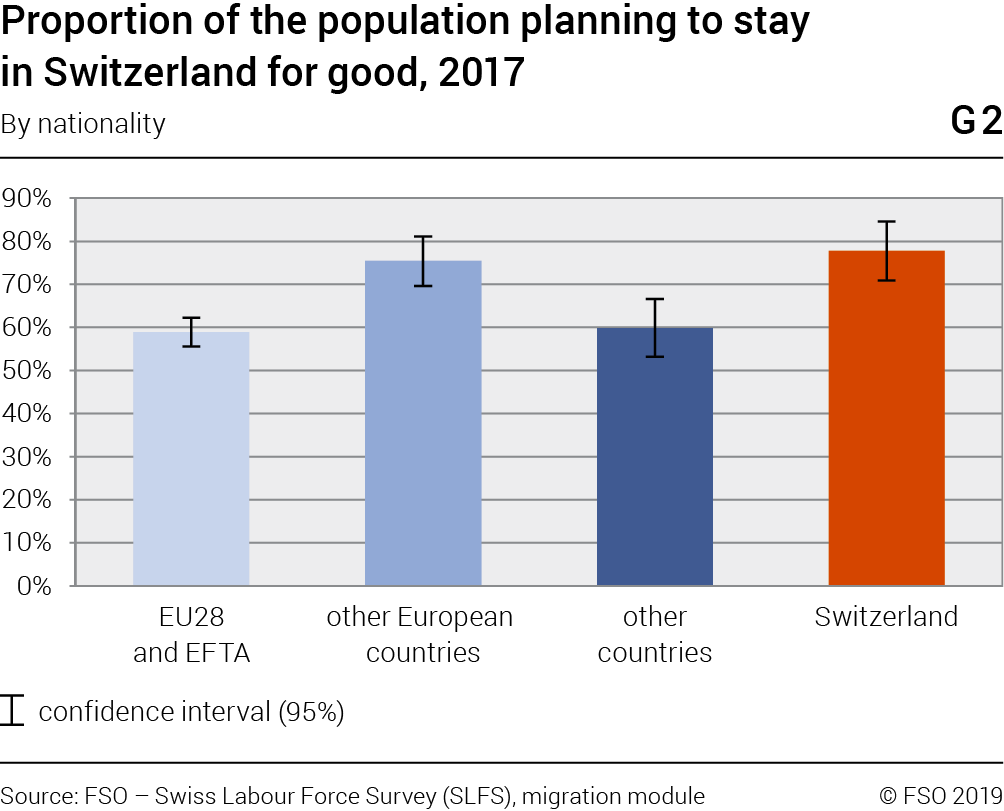
Although the majority of the analysed population planned to stay in Switzerland for good, far more people originating from European countries outside the EU28 and EFTA planned to stay in Switzerland forever, compared with persons originating from other countries in the world and EU28 and EFTA member countries (75% compared with 60% for each of the latter two groups). 78% of persons born abroad who were Swiss at the time of the survey planned to stay in Switzerland for good. This rate does not differ significantly from that of citizens from European countries outside the EU28 and EFTA.
Return to country of origin or “onward migration”
In 2017, 56% of persons aged 15 to 74 who were born abroad and planned to leave Switzerland intended to return to their country of origin. One quarter of these were thinking about migrating to another country. The rest did not reply. The share of persons intending to return to their country of origin or to migrate to another country did not vary significantly by nationality.
Reasons for leaving Switzerland
As regards motivations for leaving Switzerland, many cited professional reasons, family reasons, retirement, better quality of life, homesickness and studies. However, no one reason was mentioned significantly more often than the others.
Conditions upon arrival
The following section focuses on education, employment and language skills. These three areas involve understanding the conditions of migrants upon their arrival. What proportion of migrants were educated abroad? Did they submit requests for equivalence for their foreign diplomas, and if not, were their qualifications recognised? Among migrants, what proportion arrived in Switzerland with a signed employment contract? The answers to these questions are provided by distinguishing between the situations of migrants according to their nationality.
Education and requests for equivalence
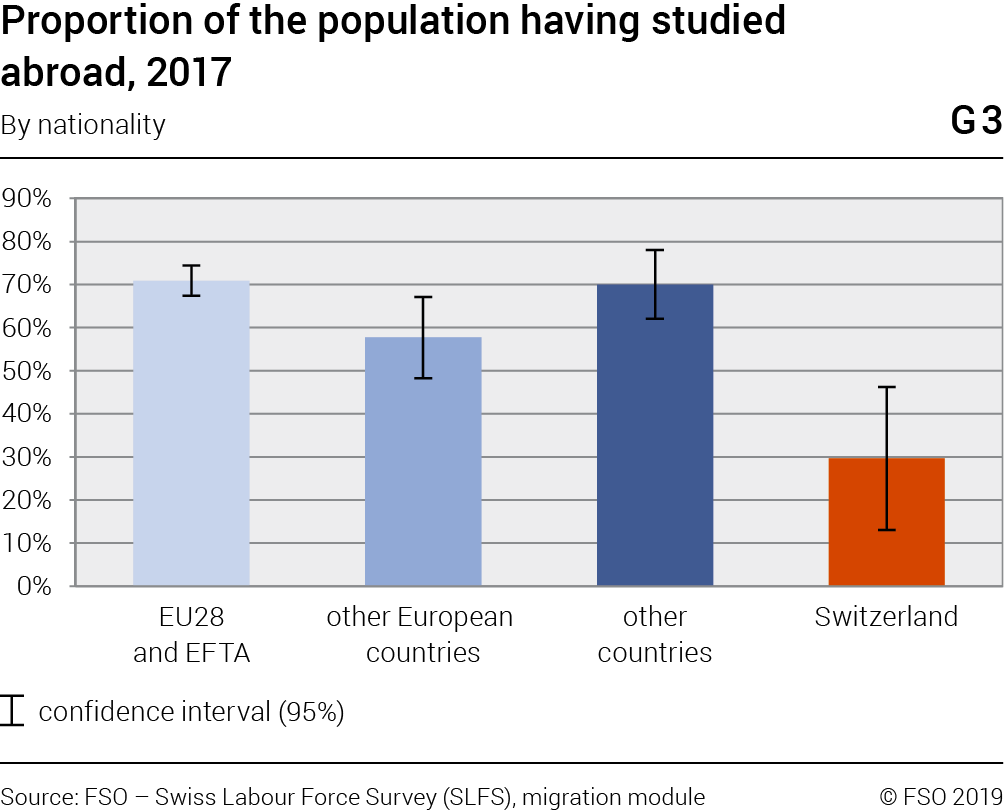
In 2017, 66% of persons aged 15 to 74 who were born abroad and had completed post-compulsory training or higher were educated or trained abroad. This percentage was higher among persons born abroad with foreign nationality than those with Swiss nationality: 58% among persons originating from European countries outside the EU28 and EFTA, 71% among citizens from the EU28 and EFTA countries and 70% among those from other countries in the world. Among Swiss nationals born abroad, 30% studied abroad.
Swiss citizens born abroad were more likely to have studied in Switzerland than foreign nationals born abroad. This can be explained by the fact that almost 100% of Swiss citizens born abroad – mostly naturalised persons – had lived in Switzerland for over 8 years, while this rate was 60% among foreign nationals born abroad.
Few people born abroad and trained abroad made use of the possibility of having their foreign diploma recognised by Switzerland. 15% requested equivalence while 83% did not. These rates do not vary significantly by nationality. 68% of persons born abroad who requested equivalence said that they had obtained this. Although the differences are not significant, persons born abroad from the EU28 and EFTA tend to be more likely to obtain equivalence (75%) than those from other European countries (55%) or from other countries in the world (45%). 71% of persons who did not request equivalence thought that they did not need it to carry out their job and 7% thought that the procedure was too complicated, too expensive or too long. The remaining 22% stated other reasons. The difference between the latter two rates is not significant from a statistical perspective.
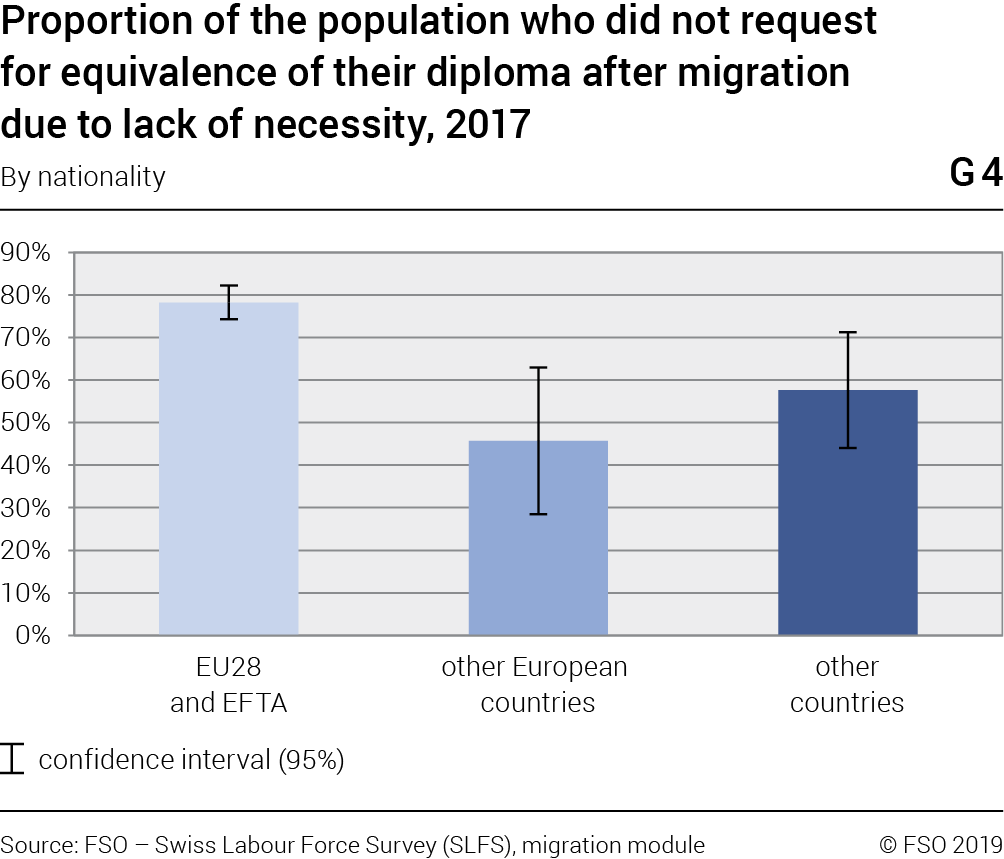
Citizens from EU28 and EFTA countries reported requesting equivalence of their diploma significantly less often because they did not need it to carry out their job – 78% compared with 45% and 58% among persons originating from European countries outside the EU28 and EFTA and from other countries in the world.
Employment
In 2017, 68% of the permanent resident population aged 15 to 74 born abroad that had migrated to Switzerland for professional reasons had already found a job prior to migration. 31% of persons who came to Switzerland for the same reasons did not have a job prior to migration.
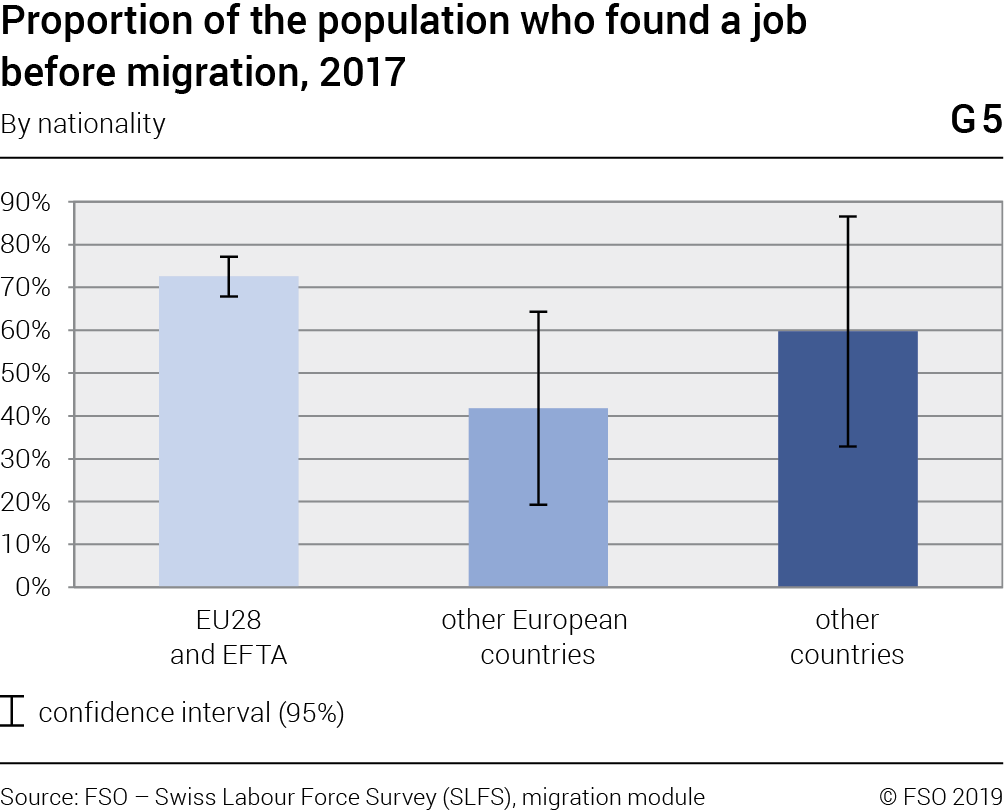
Differences can also be observed by nationality: 73% of citizens from EU28 and EFTA countries arrived in Switzerland with an employment contract, compared with 42% of citizens of countries that are not members of the EU28 and EFTA and 60% of citizens from other countries in the world. The differences between citizens from the EU28 and EFTA countries and those from other countries in the world are, however, not significant.
Almost 70% of persons who did not find a job before migrating did so less than six months after arriving in Switzerland. The time it took to find a job following migration did not vary significantly by nationality.
Language skills
Language skills influence the type of activities that migrants can engage in, especially on the labour market, but also in terms of their integration into society. A good command of one of Switzerland’s national languages can be seen as both an essential requirement and as the result of successful integration.
In 2017, 60% of the permanent resident population aged 15 to 74 who had immigrated to Switzerland after the age of 4 had oral language skills in one of the national languages prior their arrival. It is not necessarily the same language as the one spoken in the canton of residence.
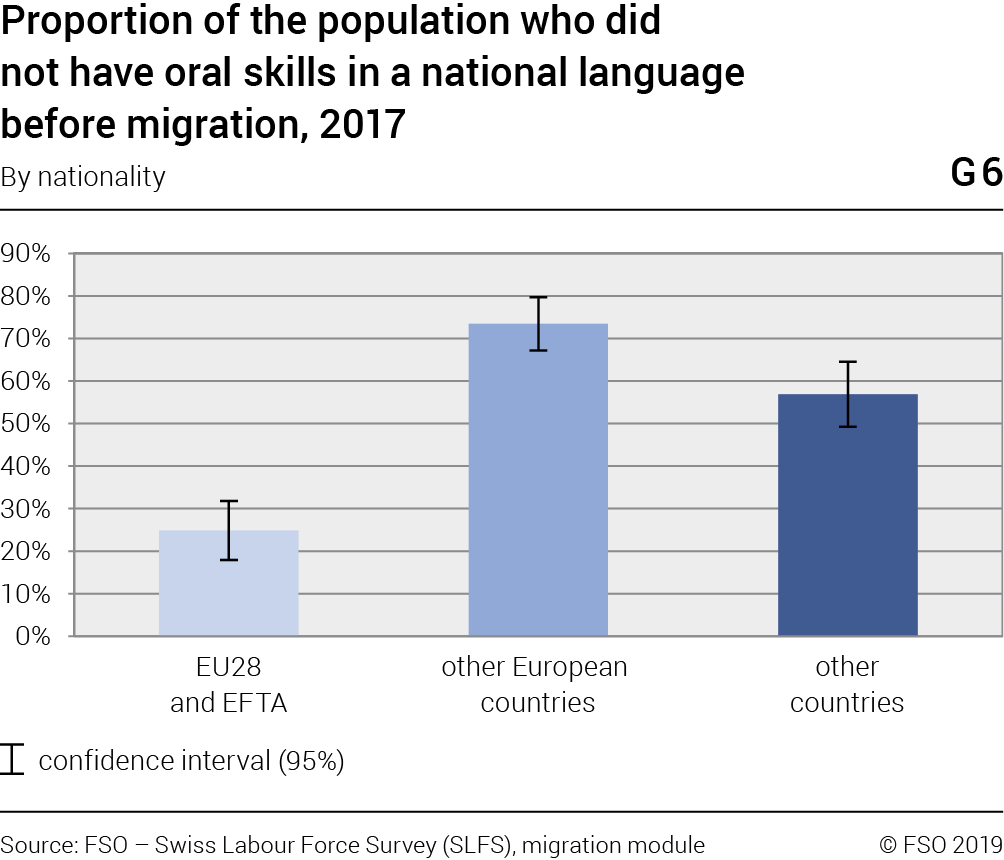
Citizens of countries that are not members of the EU28 and EFTA were most likely to have no oral language skills in one of the national languages prior to arriving in Switzerland (73%), followed by persons from other countries in the world (57%) and those from the EU28 and EFTA countries (25%).
In 2014 This variable was not available in 2017. , almost half of the permanent resident population aged between 15 and 74 who migrated to Switzerland took a language course following their arrival. 38% of them did not take a course because there was no need to do so. 13% did not take a language course for other reasons.
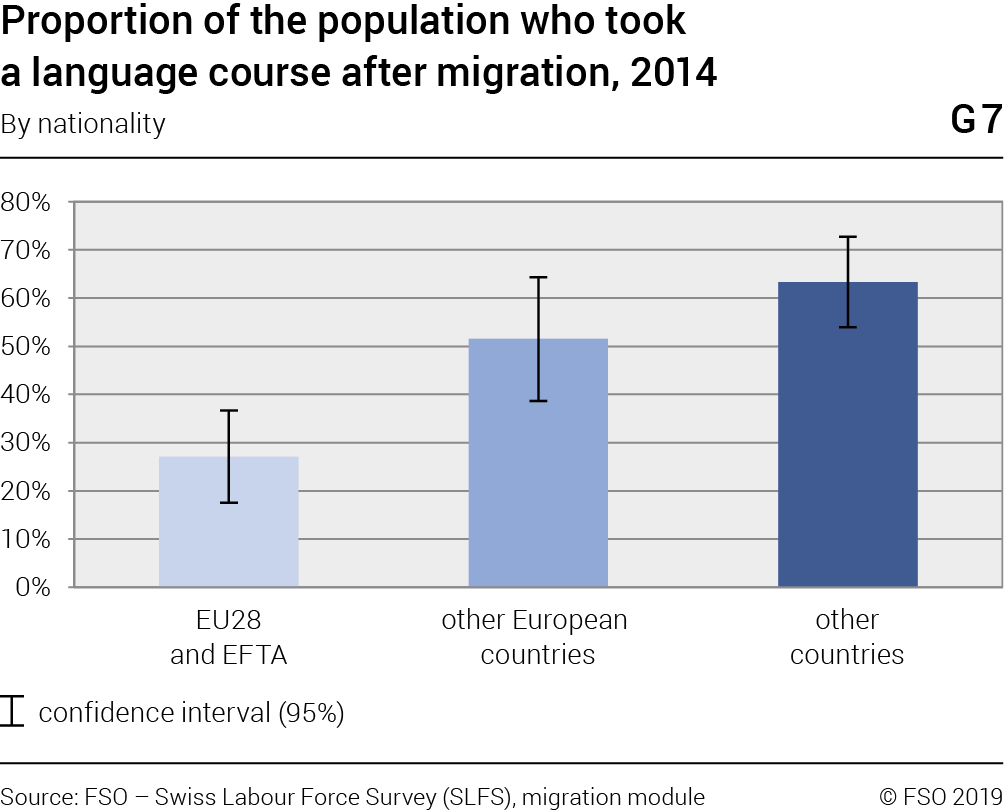
Citizens from EU28 and EFTA countries were least likely to take a language course following their arrival in Switzerland (27%), followed by persons from other European countries (52%) and from other countries in the world (63%). The difference between the latter two groups was not significant, however.
In summary
People reported that they had mainly migrated to Switzerland for family or professional reasons. As shown, these reasons varied depending on the nationality of migrants. Benefiting from the Bilateral Agreement on the Free Movement of Persons (AFMP) between Switzerland and the European Union (EU), citizens from EU28 and EFTA countries mainly migrated for professional reasons, while migration in the scope of family reunification was more frequent among other nationality groups. Persons born abroad living in Switzerland mainly saw migration as something permanent. Almost two thirds intended to stay in Switzerland for good. People originating from European countries outside the EU28 and EFTA most often said that they planned to stay in Switzerland forever. Among those who planned to leave Switzerland, most intended to return to their country of origin, regardless of their nationality.
In terms of conditions upon arrival relating to education or employment, the situation of migrants tended, depending on the indicators, to vary according to their nationality. Whereas most people born abroad aged 15 to 74 were also educated and trained abroad, few requested equivalence for recognition of their diploma in Switzerland. While it was predominantly citizens from the EU28 and EFTA countries and those from other countries in the world who reported that they had been educated or trained outside Switzerland, the proportion that requested equivalency did not vary by nationality. Most persons who did not request equivalency of their diploma believed that this was unnecessary for them to carry out a professional activity in the host country. It was predominantly citizens from the EU28 and EFTA countries who stated that there was no need for such a request. Following the bilateral agreements concluded between Switzerland and the European Union, the system of recognition of professional qualifications in the EU is also valid in the scope of relations between Switzerland and the EU and EFTA member states. annex III of the Agreement on the Free Movement of Persons Two thirds of migrants aged 15 to 74 years who came to Switzerland for professional reasons had already found a job before migrating, reflecting favourable starting conditions for quick or direct integration into the labour market. It was primarily citizens from EU28 and EFTA countries and citizens of countries outside Europe who arrived with an employment contract. Almost two thirds of people having migrated to Switzerland had oral language skills in a national language before arriving in the country. Citizens of EU28 and EFTA member countries more often had this type of skill and fewer of them took a language course after arriving in Switzerland.
Appendix
Mobility and Migration – Swiss Labour Force Survey (SLFS) module
The mobility and migration module provides data on the conditions and the history of populations with a migration background. The questions do not focus solely on the target person or the migrant, but also on his or her partner, children and parents. This set of questions on mobility and migration issues is included every three to five years to the Swiss Labour Force Survey (SLFS). The link with the SLFS data provides information on the situation of the population with a migration background on the labour market, in the training system and on their structural integration in the Swiss society.
Available since
1998
Statistical basis and survey units
Permanent resident population aged 15 or more
Main features registered
Country of birth
Nationality at birth
Application for naturalisation
Education and training in Switzerland
Language skills and language courses
Nationality of spouse before marriage
Country of birth of parents
Educational level of parents
Reasons for migration
Transnational practices
Duration of stay in Switzerland and future plans
Methodology
Survey based on sampling of individuals. The addresses are randomly selected from the FSO's sample register. This is mainly based on official records of the inhabitants of municipalities and cantons. Since 2003, an additional sampling of foreigners was selected from the central information system on migration (ZEMIS). From the 2nd quarter of 2014, this subsample is also drawn from the FSO's sample register.
Degree of regionalization
Switzerland and major regions NUTS 2
Periodicity
Every three to five years
Reference period
Second trimester (April – June)
Revisions
2001, 2003, 2008, 2014, 2017
Organization
Federal Statistical Office (FSO), in cooperation with LINK Marketing Services
Florence Bartosik and Marion Aeberli
+41 58 463 67 11